GigaPaw.com participates in affiliate programs including Amazon Associates. We earn from qualifying purchases. Content is for informational purposes only—consult a licensed veterinarian for pet medical advice.
Cat Room Ideas on a Budget: 15 Ways to Spoil Your Cat Without Going Broke

Your cat already thinks they own the entire house.
So why not make it official — and do it without maxing out your credit card?
Here’s the thing most people don’t realize: cats don’t care about price tags. That $200 cat tree from the pet store? Your cat will ignore it and sleep in the shipping box instead. Every single time.
The good news is that building a killer cat room on a budget is not only possible — it’s actually more fun than buying everything premade. And your cat will love it just as much (probably more, honestly).
Let’s get into it.
Why Your Cat Actually Needs Their Own Space
This isn’t just about spoiling your cat. There’s real science behind it.
Cats are territorial animals. They need a space they can call their own, especially in busy homes with kids, dogs, or multiple cats.
Research published in the journal Animals found that cats living in enriched environments had roughly half the cortisol (stress hormone) levels compared to cats in basic, resource-poor setups. Lower cortisol means a healthier, calmer, and overall happier cat.
Without their own territory, cats get stressed. And stressed cats do fun things like scratch your couch to shreds, pee outside the litter box, or yowl at 3 AM. Ask me how I know.
A dedicated cat space — even a small corner — gives them a retreat where they feel safe and in control.
Where to Set Up Your Budget Cat Room
You don’t need a spare bedroom. Seriously.
Here are the best spots to carve out a cat zone, ranked by how easy they are to pull off:
| Location | Why It Works | Budget Level |
|---|---|---|
| Unused closet | Private, enclosed, perfect for shy cats | Very low |
| Corner of a bedroom | Easy to set up with minimal effort | Very low |
| Under the stairs | Often wasted space, cats love the cozy vibe | Low |
| Spare bathroom | Easy to clean, already has tile floors | Low |
| Section of a living room wall | Maximum vertical space for climbing | Low-Medium |
| Attic or basement | Tons of room, but may need some prep | Medium |
| Enclosed patio or sunroom | Natural light, outdoor views — cat paradise | Medium |
The golden rule? Pick somewhere quiet, away from loud noises, and ideally near a window. Cats are obsessed with looking outside. It’s basically their version of Netflix.
The Big 5: Budget Cat Room Essentials
Before you start buying random cat stuff, focus on the five things every cat room actually needs.
1. Vertical Space (Climbing and Perching)
Cats love heights. It’s hardwired into their DNA.
They feel safer up high because they can survey their territory. In the wild, height means safety from predators. In your house, height means judging you from above.
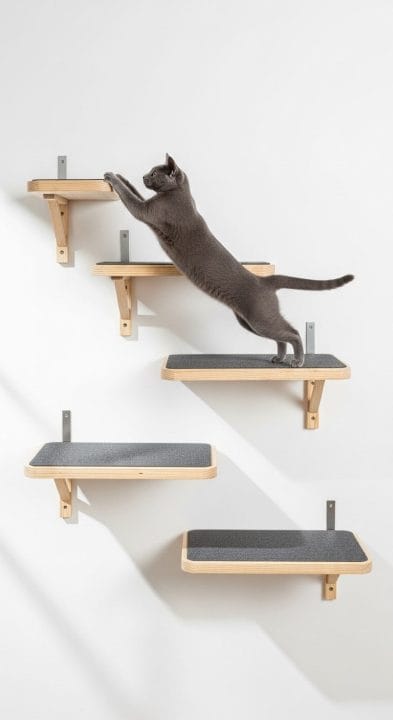
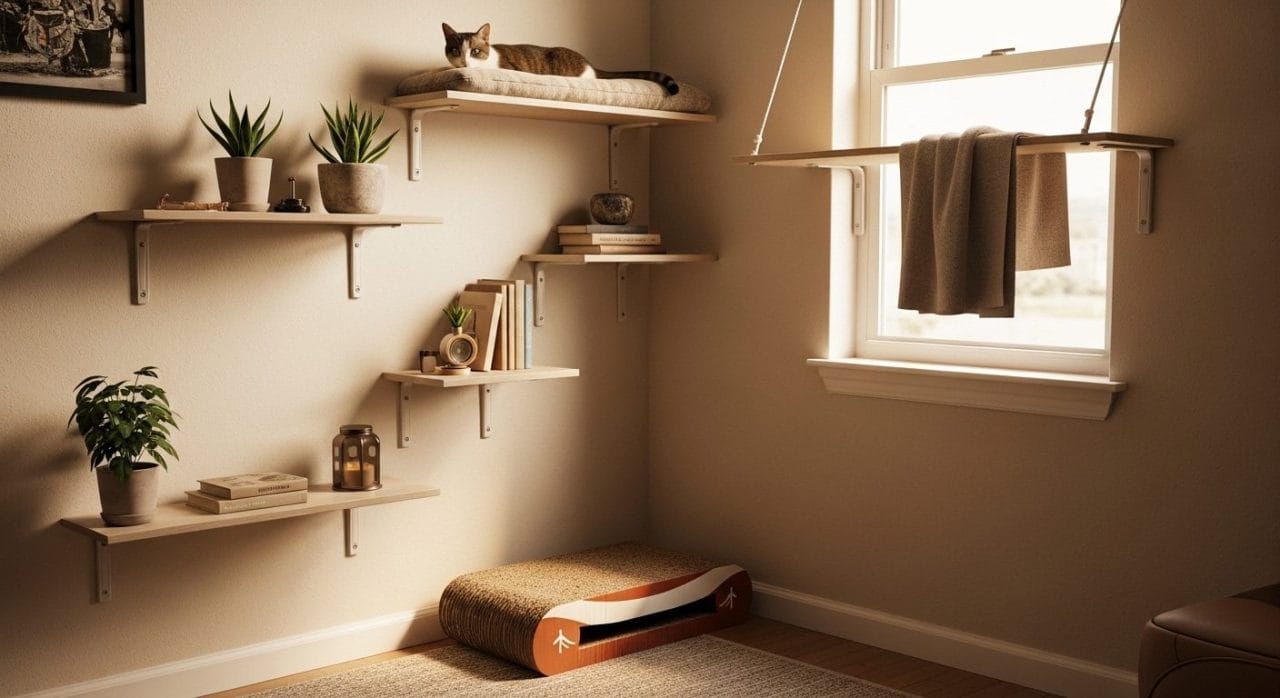
The cheapest way to add vertical space? Scrap wood and basic shelf brackets from the hardware store. A few boards mounted at staggered heights on a wall costs almost nothing, and cats go absolutely wild for it.
Mount them about 12-18 inches apart so your cat can hop between them easily. Add a strip of carpet or non-slip liner to each shelf so they don’t slide around.
Total cost: Under $20 if you use leftover wood or hit up the clearance section.
2. A Scratching Station
If you don’t give your cat something to scratch, they’ll pick something themselves. And you won’t like their choice.
Forget buying expensive scratching posts. Here are two dirt-cheap alternatives that actually work better:
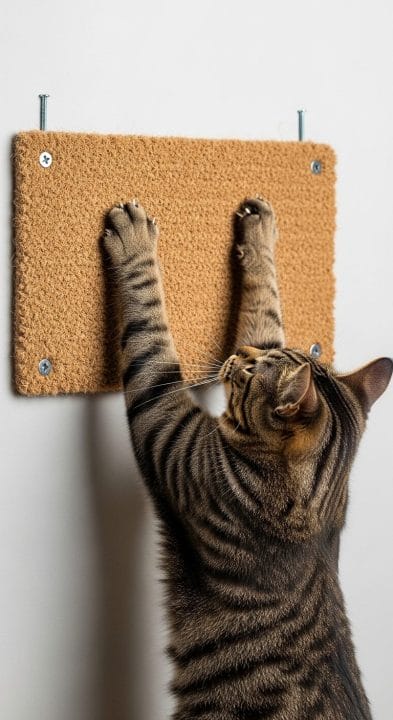
Sisal rug on the wall. Grab a cheap sisal area rug or doormat, screw it flat onto a wall at your cat’s stretching height. They can stretch out fully and go to town on it. Looks surprisingly decent too.
Cardboard scratchers. Stack corrugated cardboard strips into a box, tape them tight, and you’ve got a scratcher that cats prefer over most store-bought options. Replace it when it falls apart — which will cost you literally nothing.
3. Hiding Spots
Cats need places to disappear.
This isn’t being antisocial — hiding is how cats cope with stress and recharge their batteries. Studies on shelter cats consistently show that providing hiding boxes significantly reduces stress behaviors and cortisol levels.
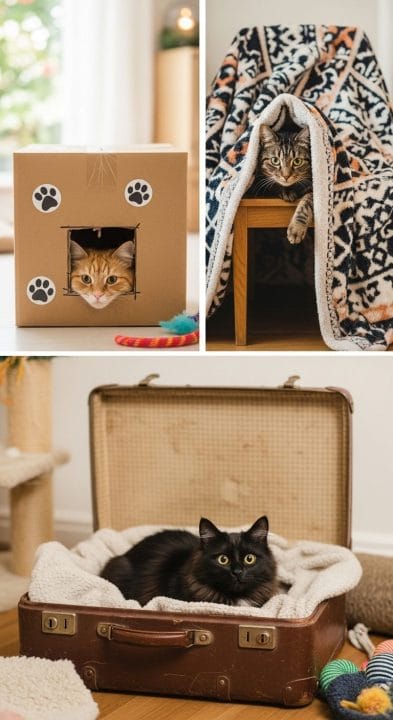
Free options: Cardboard boxes (cut doorways into them), paper shopping bags with handles cut off, a blanket draped over a chair.
Almost-free options: Old suitcase lined with a fleece blanket, overturned plastic storage bin with a door cut out, a pillow stuffed into a cubby hole.
Your cat does not care if their hiding spot cost $0 or $50. They care that it exists.
4. A Window Perch
Nothing — and I mean nothing — keeps a cat more entertained than a window with a view.
Bird watching is the ultimate free cat enrichment. It engages their hunting instincts, keeps their brain active, and provides hours of entertainment while you’re at work.
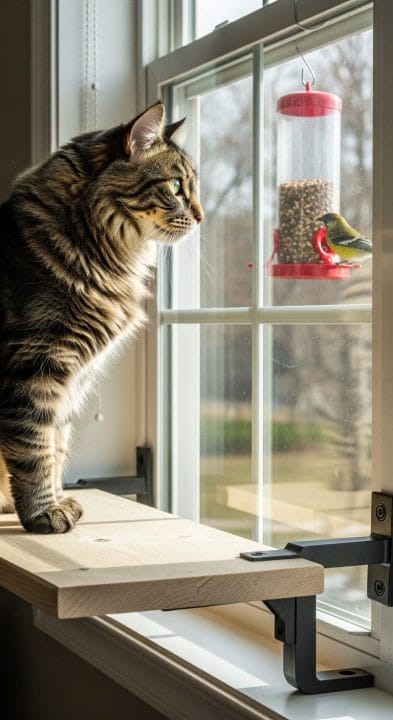
Budget option: Clear a spot on a windowsill and add a folded towel. Done.
DIY option: Build a simple shelf that extends from the windowsill using a plank and two L-brackets. Cover with fabric or carpet. Costs about $10-15 in materials and looks way more expensive than it is.
Pro tip: Hang a bird feeder outside the window. You’ve just created Cat TV, and the subscription is free.
5. A Cozy Sleeping Spot
Cats sleep 12-16 hours a day. They take sleep very seriously.
But here’s the secret: you don’t need to buy a cat bed. Most cats prefer sleeping on something that smells like you anyway.
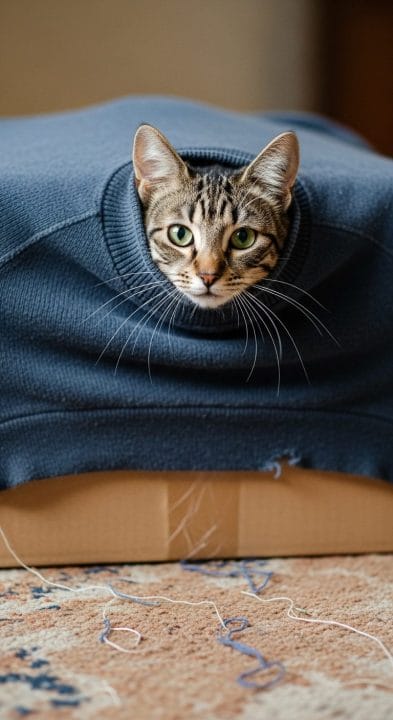
Fold up an old hoodie or sweater and place it on a shelf. Stuff an old pillowcase with a folded towel. Line a small cardboard box with a soft blanket.
One viral DIY that cat owners swear by: slide an old crew-neck sweater over a small cardboard box, with the neck hole facing out as the entrance. Tuck the sleeves behind and you’ve got a cozy little cat cave in about 3 minutes.
10 DIY Cat Room Ideas That Cost Almost Nothing
Now let’s get to the good stuff. Here are specific projects you can knock out this weekend.
Turn an Old Bookshelf Into a Cat Playground
Got a bookshelf collecting dust? Remove a few shelves, add some soft padding to the remaining ones, and cut a few holes between levels.
Boom — multi-level cat jungle gym.
Wrap one side with sisal rope for scratching and toss some dangling toys from the top shelf. This is one of the most popular budget cat room ideas on the internet for a reason. It works, it looks cool, and it costs basically nothing if you already have the bookshelf.
Build a Cat Wall Highway
This is the project that makes people think you spent serious money.
Mount a series of shelves at different heights along a wall. Space them so your cat can jump from one to the next. Add a couple of small enclosed boxes or cubbies along the route for rest stops.
The key rule: Give your cat a way up AND a way down without having to turn around. Cats hate backing up on narrow surfaces.
Use non-slip drawer liner on each shelf surface — you can grab this at the dollar store. Your cat will actually use the shelves instead of staring at them in suspicion.
IKEA Hacks That Cat Owners Love
IKEA is basically a cat furniture goldmine if you know what to look for.
| IKEA Product | Cat Hack | Approximate Cost |
|---|---|---|
| LACK side table ($12.99) | Stack multiple for a cat tree. Wrap legs with sisal rope | $25-40 |
| KALLAX shelf unit | Insert cat cubbies and beds in open cubes | $35-70 |
| DUKTIG doll bed ($14.99) | Use as-is — it’s already cat-sized. Stack two with mending plates for bunk beds | $15-30 |
| LURVIG pet bowls | Elevated feeding station | $5-10 |
| Picture ledges (MOSSLANDA) | Mount as cat walkway shelves | $10-20 |
| BESTA cabinet | Hide litter box inside with a cat-door cutout | $50-80 |
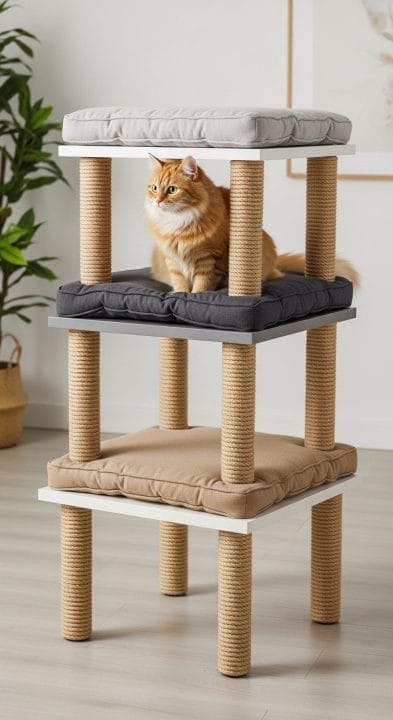
The LACK side table hack is probably the most famous. At roughly $13 per table, you can stack three or four, wrap the legs in rope, add some cushions, and build a cat tree that rivals $150+ store-bought versions.
The DUKTIG doll bed is another legend. It’s literally designed to be a tiny bed — cats love it without any modifications at all. Stack two with some hardware and you’ve got bunk beds. That’s peak cat room energy right there.
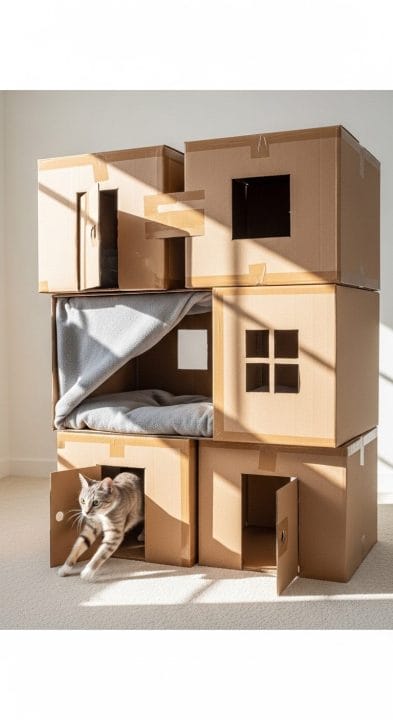
The $0 Cardboard Box Fort
I’m not joking. This is genuinely one of the best cat room ideas you can do.
Collect a bunch of shipping boxes. Cut doorways between them so your cat can run through. Stack them, tape them together, cut some peek-a-boo windows.
Your cat will lose their mind over this.
Upgrade it by lining the floors of each box with fleece or felt. Want to get fancy? Use contact paper on the outside so it doesn’t look like a recycling bin exploded in your living room.
Replace the whole thing every few weeks when it gets ratty. Cost: literally $0.
Convert an Unused Closet
This one is pure genius for small apartments.
Clear out a closet. Install a few floating shelves at different heights for climbing. Put the litter box on the bottom with a cat door cut into the closet door. Add a bed on the top shelf.
Everything your cat needs is in one spot. The door stays closed. Your apartment stays clean. And your cat has a private suite that they’ll love way more than having free rein over your entire bathroom.
DIY Macrame Cat Hammock
If you’re even a little bit crafty, macrame cat hammocks are a surprisingly easy project.
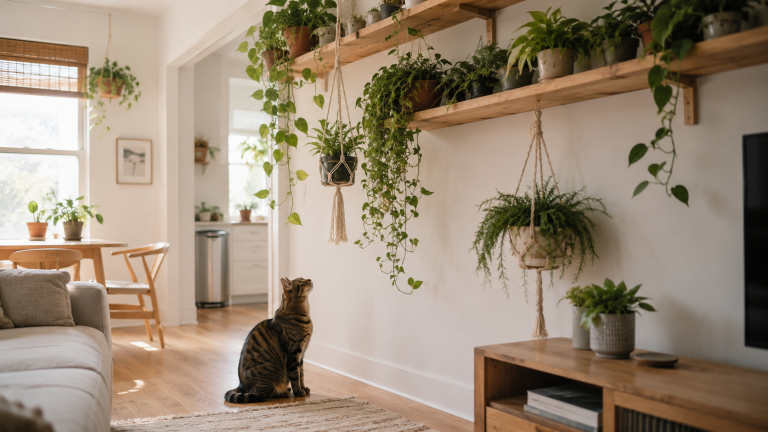
You can learn basic macrame knots from a YouTube tutorial in about 20 minutes. Use thick cotton rope from the hardware store, tie a hanging hammock, and mount it from a ceiling hook or between two wall brackets.
Cats love hammocks because they can curl into the fabric while still seeing everything around them. It’s like a high-up hiding spot with a view. The best of both worlds.
Old T-Shirt Rope Toys
Cut old t-shirts into strips. Braid three strips together tightly and tie knots at each end.
You’ve just made a tug toy, a batting toy, and a fetch toy all in one. Make a few of different lengths. Tie one to a stick for an interactive wand toy.
Total cost: whatever you were going to throw away anyway.
The Cardboard Scratching Pad
Cut corrugated cardboard into strips about 3-4 inches wide. Stack them tightly inside a shallow box or container so the corrugated edges face up. Pack them in tight so they don’t fall apart.
Sprinkle a little catnip on top.
Cats LOVE this type of scratcher. The texture is perfect for their claws, and you can make one in about 15 minutes. When it wears out, make another.
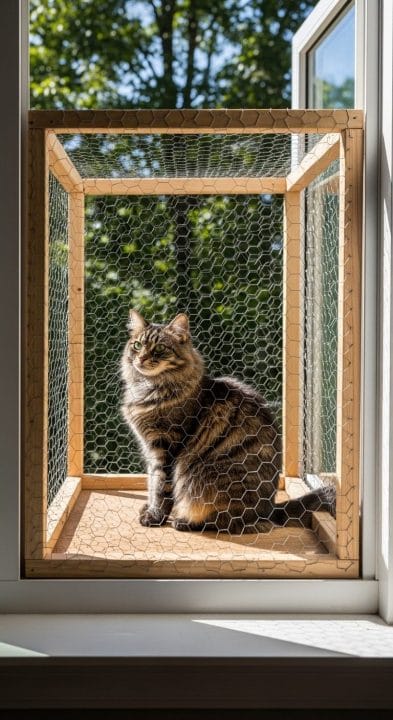
A “Catio” on the Cheap
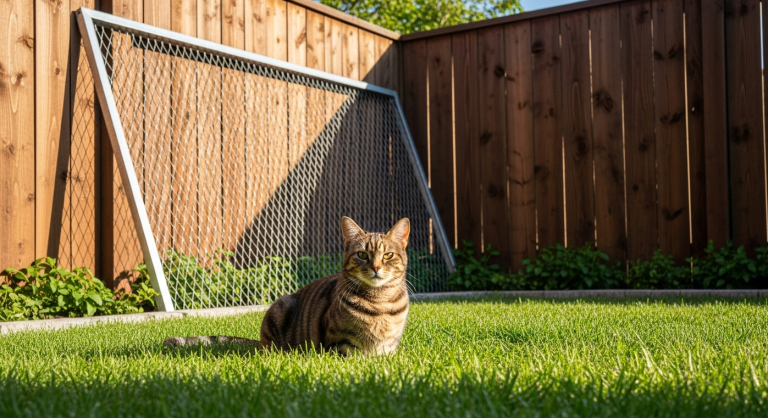
If you have a window that opens or a small balcony, you can build a mini catio (cat patio) using basic wood frames and chicken wire.
This gives your indoor cat safe outdoor access without the risk of them disappearing into the neighborhood. Even a small 2×3 foot window box version makes a massive difference in your cat’s quality of life.
Budget range: $30-100 depending on size and materials. Some cat owners have built them using IKEA wooden shelf units and chicken wire for under $50.
Puzzle Feeders From Household Items
Mental stimulation is just as important as physical exercise for cats.
Cut holes in a plastic water bottle just big enough for kibble to fall out when your cat bats it around. Or poke holes in a cardboard egg carton and hide treats inside.
Muffin tins with tennis balls placed on top of treats work great too.
These DIY puzzle feeders slow down fast eaters, fight boredom, and give your cat a satisfying challenge — all for free.
Budget Cat Room Tips That Save You Real Money
Buy Secondhand
Facebook Marketplace and thrift stores are goldmines for cat room supplies. People sell barely-used cat trees for a fraction of the original price all the time. Same goes for shelving units, baskets, and storage cubes.
Don’t buy new unless you absolutely have to.
Prioritize Two Things First
If you can only afford to do two things, make them these:
Vertical territory (wall shelves or a cat tree) and a hidden litter box solution (cabinet, closet conversion, or enclosed bench). These two changes make the biggest difference in your cat’s happiness and your home’s appearance.
Everything else — toys, beds, hammocks — can be added over time.
Use the “One Cat, One Box, Plus One” Rule
For litter boxes, always have one more box than you have cats. Two cats? Three boxes. Place them in different spots to prevent territorial issues.
This isn’t a budget tip exactly, but it prevents a lot of expensive behavioral problems down the road — like your cat deciding your bed is a better bathroom option.
Rotate Toys Instead of Buying New Ones
Cats get bored with toys they see every day. But a toy they haven’t seen in two weeks? That’s suddenly the most exciting thing in the world.
Keep a stash and rotate them weekly. Your cat will think they’re getting new toys constantly, and you’ll save a ton of money.
Common Mistakes to Avoid
Don’t put food near the litter box. Would you eat dinner in your bathroom? Neither would your cat.
Don’t skip the non-slip surfaces. Shelves without grip = shelves your cat will never use. Dollar store drawer liner solves this instantly.
Don’t forget multiple escape routes. Cats hate being cornered. Every perch, shelf, or hiding spot should have at least two ways in and out.
Don’t use toxic materials. If you’re painting or staining any DIY projects, make sure you use non-toxic, pet-safe products. Let everything cure completely before your cat gets access.
Don’t overcrowd the space. A few well-placed items beat a cluttered mess every time. Cats like open sightlines where they can see what’s coming.
The Bottom Line
You can build an awesome cat room for under $50 if you’re willing to get a little creative with DIY projects and secondhand finds. Some of the best setups out there cost almost nothing — just some cardboard, scrap wood, and a little imagination.
Your cat doesn’t care about brand names or Instagram aesthetics. They care about having places to climb, scratch, hide, sleep, and watch birds.
Give them that, and you’ll have the happiest cat on the block.
Now stop reading and go raid your recycling bin. Your cat room is waiting to be built.