GigaPaw.com participates in affiliate programs including Amazon Associates. We earn from qualifying purchases. Content is for informational purposes only—consult a licensed veterinarian for pet medical advice.
Cat Chonk Chart: The Hilarious (But Secretly Important) Guide to Your Cat’s Body Type

Look, we need to talk about your cat.
You know, the one that waddles to the food bowl like a furry bowling ball on legs. The one that knocks stuff off counters not out of spite, but because turning around is a whole production now.
The internet gave us the perfect tool to have this conversation. It’s called the Chonk Chart, and it might be the funniest thing that also lowkey saves your cat’s life.
What Is the Cat Chonk Chart?
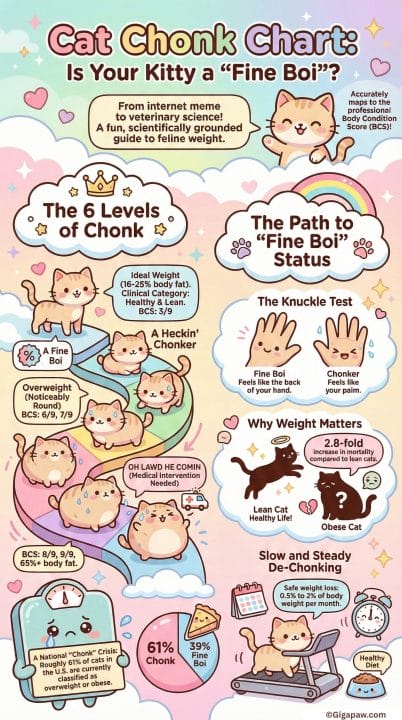
Back in August 2018, someone named Emilie Chang took a standard veterinary cat body-fat index chart and gave it a total makeover.
Instead of boring clinical terms like “overweight” and “obese,” she slapped on labels like “A Fine Boi” and “OH LAWD HE COMIN.”
She posted it to the Facebook group “THIS CAT IS C H O N K Y,” and the internet lost its collective mind.
The chart blew up on Twitter after user @dreamlandtea shared it, racking up over 37,000 retweets and 94,000 likes. Then Reddit got hold of it. Then TikTok. Then your aunt’s group chat.
And just like that, the word “chonk” entered the permanent cat vocabulary.
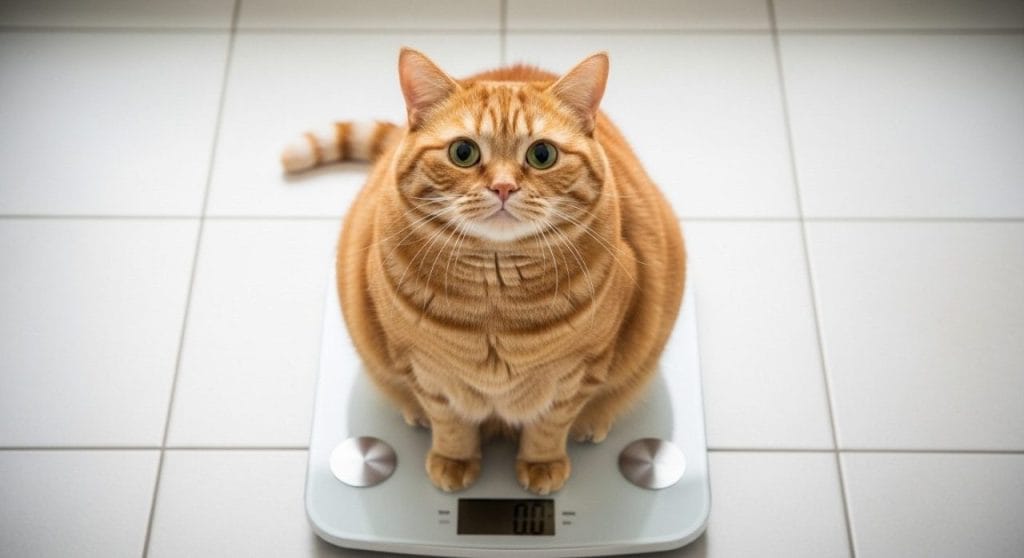
The 6 Levels of Chonk, Explained
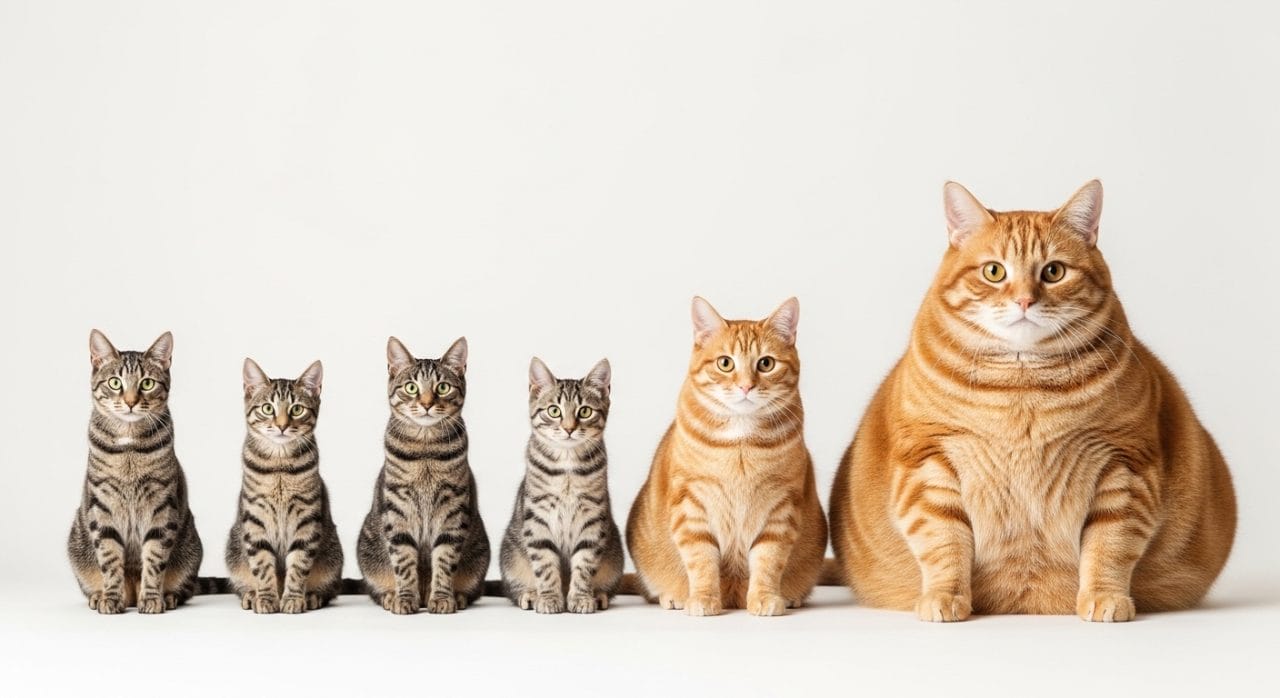
Here’s the full breakdown of where your cat falls on the legendary scale:
| Chonk Level | Label | Body Fat % | What It Actually Means |
|---|---|---|---|
| 1 | A Fine Boi | 16-25% | Lean, healthy, the cat equivalent of someone who actually uses their gym membership |
| 2 | He Chomnk | 26-35% | A little plump, still cute, basically your cat after the holidays |
| 3 | A Heckin’ Chonker | 36-45% | Noticeably round, ribs are playing hide-and-seek, time to pay attention |
| 4 | HEFTYCHONK | 46-55% | Your cat has entered the “I can hear them walking” phase |
| 5 | MEGACHONKER | 56-65% | We’re in trouble territory now, vet visit is overdue |
| 6 | OH LAWD HE COMIN | 65%+ | Maximum chonk, your cat needs medical intervention yesterday |
The chart is hilarious. Nobody’s arguing that.
But here’s the thing most people miss: it’s surprisingly accurate.
How the Chonk Chart Maps to Actual Vet Science
Veterinarians use something called the Body Condition Score (BCS), a 9-point scale developed by Purina researcher Dr. Dottie Laflamme back in 1997.
A score of 5 out of 9 means your cat is at a healthy weight. You can feel their ribs with light pressure, they’ve got a visible waist from above, and their belly tucks up slightly when you look from the side.
Here’s how the chonk levels roughly line up with the real BCS:
| Chonk Level | BCS Score (1-9) | Clinical Category |
|---|---|---|
| A Fine Boi | 4-5 | Ideal weight |
| He Chomnk | 6 | Slightly overweight |
| A Heckin’ Chonker | 7 | Overweight |
| HEFTYCHONK | 8 | Obese |
| MEGACHONKER | 8-9 | Severely obese |
| OH LAWD HE COMIN | 9+ | Morbidly obese |
So yeah, the meme chart that your coworker printed out and taped to the breakroom wall? It’s basically a vet-approved diagnostic tool wearing a funny hat.
Why This Actually Matters (The Part Nobody Wants to Hear)
Here’s where the comedy takes a sharp turn.
About 61% of cats in the United States are overweight or obese. That’s according to the Association for Pet Obesity Prevention’s survey data. More than half of all pet cats are carrying too much weight.
And get this: a 2024 study looking at nearly 1.3 million cats found that overweight and obese conditions peak during the “mature” life stage, with almost 45% of adult cats and over 21% of mature cats classified as obese.
We’re not talking slightly pudgy. We’re talking clinically, medically, dangerously heavy.
What Happens When Your Cat Stays in “OH LAWD” Territory
Obese cats face a long list of health problems that are way less funny than the meme:
Diabetes is a big one. Cats carrying excess weight are significantly more likely to develop Type 2 diabetes than cats at a healthy weight.
Arthritis gets worse. Extra pounds put extra stress on joints, and cats are already masters at hiding pain.
Liver disease is a serious risk. If an obese cat stops eating suddenly, even for just 2-3 days, they can develop hepatic lipidosis (fatty liver disease), which can be fatal.
Shorter lifespan is the bottom line. Research shows that obese cats aged 8-12 have a 2.8-fold increase in mortality compared to lean cats of the same age. That’s not a small difference. That’s nearly three times the risk.
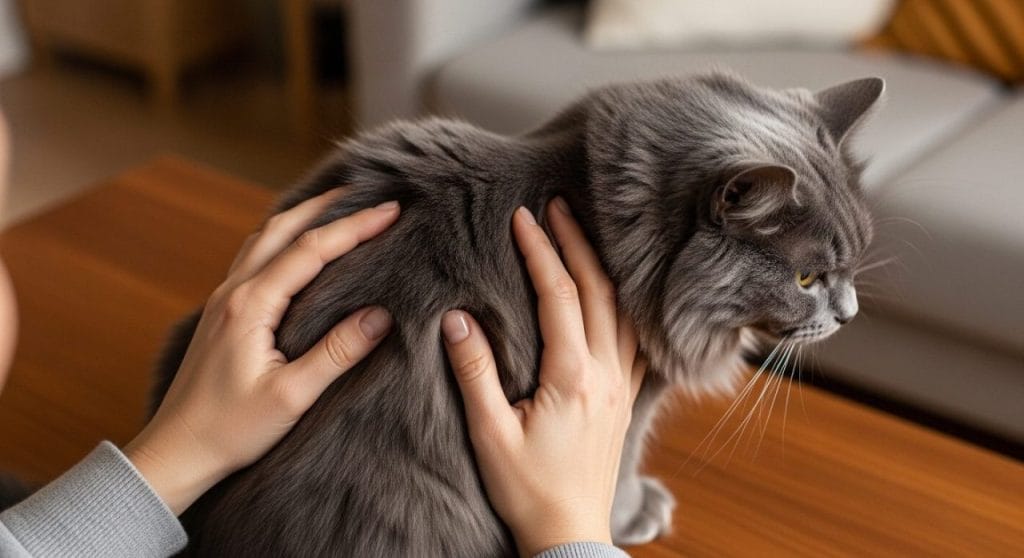
The “Knuckle Test”: How to Score Your Cat at Home
You don’t need a fancy scale or a vet visit to get a rough idea of where your cat falls.
Try this right now.
Step 1: The Rib Check
Place your hands on your cat’s sides, right behind their front legs.
Make a fist and feel your knuckles. That’s what a too-thin cat’s ribs feel like. Sharp, prominent, no padding.
Now open your hand and feel the back of your hand. That slight padding over the knuckles? That’s ideal. A thin layer of fat with ribs right underneath.
Now flip your hand and try to feel your knuckles through your palm. Hard, right? That’s what an overweight cat’s ribs feel like. Buried under too much fat.
Step 2: The Bird’s Eye View
Stand above your cat while they’re standing.
A healthy cat has an hourglass shape. You should see a slight inward curve behind the ribs, where the waist narrows before the hips.
If your cat looks like a loaf of bread from above, no curve, just straight sides or bulging outward, you’ve got a chonk situation.
Step 3: The Side Profile
Look at your cat from the side.
A healthy cat’s belly should slope upward slightly between the ribcage and the hind legs. That’s called the “abdominal tuck.”
If the belly hangs down or sags, that’s excess fat. (Note: the primordial pouch, that loose flap of skin near the hind legs, is totally normal and not a sign of obesity. Every cat has one to some degree.)
The Internet’s Complicated Relationship with Chonky Cats
The Chonk Chart spawned an entire subculture.
The subreddit r/chonkers grew to over 1.4 million subscribers, all posting photos of their rotund felines with captions like “absolute unit” and “heckin’ chonker.”
But it also sparked a genuine backlash.
Multiple Change.org petitions popped up demanding the subreddit be shut down, accusing it of glorifying pet obesity and encouraging people to overfeed their cats for internet points.
The debate is real and it’s worth thinking about.
On one side, people argued that celebrating fat cats online normalizes something that’s genuinely dangerous for the animal. When you see thousands of upvotes on a photo of a cat that can barely walk, it sends a message.
On the other side, the communities themselves pushed back. The founder of Facebook’s “This Cat is C H O N K Y” group pointed out that most members aren’t intentionally fattening their cats. They’re sharing photos of pets they love. The group actually forbids medical advice-giving, pushing people toward actual vets instead.
The truth? It’s probably somewhere in the middle.
Laughing at a chonky cat photo isn’t animal abuse. But thinking your cat’s obesity is just “cute” and doing nothing about it might be.
How Cats Get Chonky in the First Place
It doesn’t happen overnight. Your cat didn’t wake up one morning as a MEGACHONKER.
Free Feeding is the Biggest Culprit
Leaving a bowl of dry food out all day and topping it off whenever it looks low? That’s basically an all-you-can-eat buffet with zero closing time.
Cats in the wild eat small, frequent meals throughout the day because they have to hunt. Your indoor cat has zero hunting to do and unlimited access to calories.
Cats fed predominantly dry food are up to 2.4 times more likely to be overweight than cats eating mostly wet food.
Neutering Changes Everything
After getting spayed or neutered, cats’ metabolism drops and their appetite increases.
Research shows that freely fed cats gained up to 43% more body weight within just 3 months after being neutered. That’s wild.
Indoor Cats Have It Rough
An indoor cat’s biggest physical challenge is jumping onto the couch.
Without outdoor exploration, climbing, hunting, and territory patrols, they’re burning a fraction of the calories their bodies are built to use.
How to De-Chonk Your Cat (Safely)
Alright, so your cat scored a solid HEFTYCHONK. Now what?
Do not crash diet your cat. This is literally life-or-death stuff. Cats who lose weight too quickly can develop hepatic lipidosis, that fatal liver condition mentioned earlier.
Here’s the safe approach:
- Talk to your vet first. They’ll calculate your cat’s ideal weight and create a calorie plan. Every cat is different.
- Switch to measured meals. Two to three meals a day at specific times, with precisely measured portions. No more “topping off the bowl” situation.
- Consider wet food. It has more moisture, fewer calories per bite, and keeps cats fuller longer.
- Slow and steady wins. A healthy rate of weight loss for cats is about 0.5% to 2% of body weight per month. That’s it. Patience is the game.
- Add play time. Laser pointers, feather wands, crinkle balls. Anything that gets your cat moving for 10-15 minutes a day makes a difference.
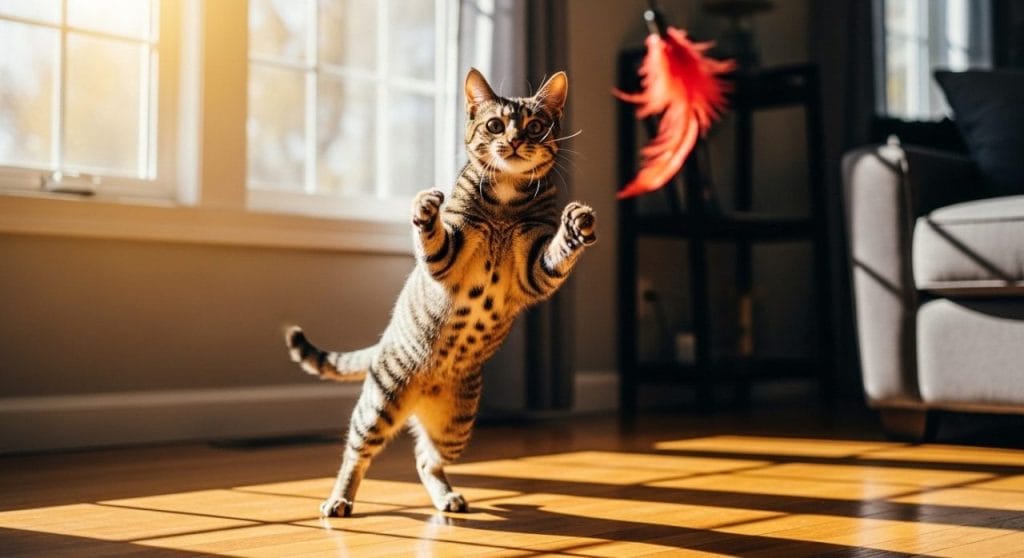
The “Fine Boi” Goal
Every cat on the chonk chart deserves a shot at becoming a Fine Boi again.
Not because fat cats aren’t adorable. They absolutely are. The internet has made that abundantly clear.
But because a Fine Boi cat lives longer, moves better, feels less pain, and has way fewer vet bills.
Your cat doesn’t know they’re a meme. They just know their joints hurt when they jump, or they can’t groom their own back anymore, or breathing is harder than it used to be.
They’re counting on you to notice.
So Where Does Your Cat Land?
Go ahead. Do the knuckle test. Check the bird’s eye view. Look at the side profile.
Be honest with yourself about where your cat falls on the chonk chart. It’s funny, sure. But it’s also one of the easiest health assessments you’ll ever do.
And if your cat is deep into HEFTYCHONK territory or beyond, don’t panic. Just call your vet. Make a plan. Start slow.
Because the best version of the chonk chart? It’s the one where your cat is working their way back toward “A Fine Boi.”
And trust me, they’ll still be just as cute when they get there.