
GigaPaw.com participates in affiliate programs including Amazon Associates. We earn from qualifying purchases. Content is for informational purposes only—consult a licensed veterinarian for pet medical advice.
Cat Feeding Chart by Age and Weight (So You Can Stop Eyeballing It)

Let’s be honest.
You’ve been scooping food into that bowl like you’re seasoning a cast iron skillet — a little of this, a little of that, whatever feels right.
And your cat? Your cat has been staring at you like you’re either the greatest chef who ever lived or the worst. There is no in between.
The thing is, feeding a cat isn’t supposed to be a guessing game. There are actual numbers. Real portions. Science-backed charts that tell you exactly how much food your cat needs based on how old they are and how much they weigh.
And yet, roughly 61% of cats in the United States are overweight or obese. So clearly, we’re all just winging it.
Not anymore. This is the chart. The one you bookmark and actually use.
Why Getting Portions Right Actually Matters
Before we get into the numbers, let’s talk about why this isn’t just a “nice to know” thing.
Overfeeding your cat doesn’t just make them chunky. It puts them at real risk for diabetes, high blood pressure, joint problems, and a shorter lifespan.
Underfeeding isn’t great either. A cat that’s not getting enough calories will lose muscle mass, have a dull coat, and become lethargic.
The goal is that sweet spot where your cat has energy, maintains a healthy weight, and doesn’t look at you with pure betrayal when you put the food bag away.
The Quick Rule: Calories Per Pound
Here’s the simplest formula to remember:
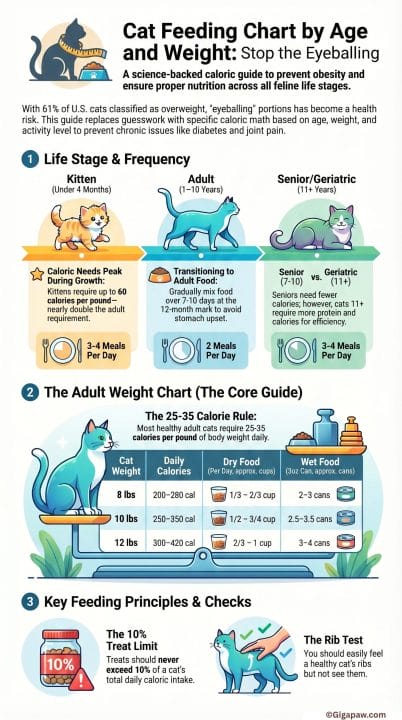
Most adult cats need 25-35 calories per pound of body weight per day.
So if your cat weighs 10 pounds, you’re looking at roughly 250-350 calories per day. That’s it. That’s the math.
But here’s the catch — individual cats can vary by as much as 50% in either direction. An active outdoor cat burns way more than a couch potato who considers walking to the litter box their daily cardio.
So treat the charts below as a starting point, not gospel.
Cat Feeding Chart by Age
This is the big one. Your cat’s age changes everything about how much and how often they eat.
Newborn to 4 Weeks (Bottle Babies)
If you’re raising a kitten this young, you’re basically a surrogate cat mom. Respect.
| Age | What to Feed | How Much | How Often |
|---|---|---|---|
| 0-1 week | Kitten milk replacer (KMR) | 2-6 mL per feeding | Every 2 hours |
| 1-2 weeks | KMR | 6-10 mL per feeding | Every 2-3 hours |
| 2-3 weeks | KMR | 10-14 mL per feeding | Every 3-4 hours |
| 3-4 weeks | KMR + intro to gruel | 14-18 mL per feeding | Every 4-5 hours |
At this stage, you’re not sleeping. The kitten’s not sleeping. Nobody’s sleeping. It’s basically having a newborn human except this one has claws.
4 to 8 Weeks (Weaning Phase)
This is where things start getting fun. Your kitten is transitioning from liquid to solid food.
Start mixing kitten wet food with warm water or KMR to make a gruel. Think oatmeal consistency. Gradually reduce the liquid over a few weeks until they’re eating straight wet food.
| Age | What to Feed | How Much | How Often |
|---|---|---|---|
| 4-5 weeks | Gruel (wet food + KMR) | As much as they want | 4-5 times per day |
| 5-6 weeks | Thicker gruel, intro dry kibble | As much as they want | 4 times per day |
| 6-8 weeks | Wet food + dry kitten food | As much as they want | 3-4 times per day |
Yes, “as much as they want” is the actual recommendation here. Kittens this age are growing at warp speed and need all the fuel they can get. Don’t restrict them.
2 to 6 Months (Growth Spurt Central)
Your kitten is now a tiny chaos machine that somehow needs about 60 calories per pound of body weight — nearly double what an adult cat needs.
| Weight | Daily Calories | Dry Food (per day) | Wet Food (per day) | Meals Per Day |
|---|---|---|---|---|
| 2 lbs | 120 cal | 1/4 cup | 1.5 cans (3 oz) | 3-4 |
| 3 lbs | 180 cal | 1/3 cup | 2 cans (3 oz) | 3-4 |
| 4 lbs | 240 cal | 1/2 cup | 2.5 cans (3 oz) | 3 |
These tiny monsters will act like they’re starving 24/7. That’s normal. They’re literally building an entire cat body from scratch.
6 to 12 Months (Teenager Phase)
Growth starts slowing down, but your cat is still developing. Think of this as the awkward teenager phase — they’re lanky, clumsy, and still need extra calories.
| Weight | Daily Calories | Dry Food (per day) | Wet Food (per day) | Meals Per Day |
|---|---|---|---|---|
| 5 lbs | 200 cal | 1/2 cup | 2.5 cans (3 oz) | 2-3 |
| 6 lbs | 225 cal | 1/2 cup | 2.5-3 cans (3 oz) | 2-3 |
| 8 lbs | 275 cal | 2/3 cup | 3 cans (3 oz) | 2-3 |
Around the 10-12 month mark, you can start transitioning from kitten food to adult food. Do it gradually over 7-10 days — mix increasing amounts of adult food with decreasing amounts of kitten food.
Don’t just switch overnight. Your cat’s stomach will make you pay for that decision.
Cat Feeding Chart by Weight (Adults 1-10 Years)
Alright, your cat is an adult now. This is the chart you’ll use for most of their life.
Based on 25-35 calories per pound of body weight:
| Cat Weight | Daily Calories | Dry Food (per day) | Wet Food (per day) | Mixed (dry + wet) |
|---|---|---|---|---|
| 5 lbs | 125-175 cal | 1/4 – 1/3 cup | 1.5-2 cans (3 oz) | 1/8 cup + 1 can |
| 7 lbs | 175-245 cal | 1/3 – 1/2 cup | 2-2.5 cans (3 oz) | 1/4 cup + 1 can |
| 8 lbs | 200-280 cal | 1/3 – 2/3 cup | 2-3 cans (3 oz) | 1/4 cup + 1.5 cans |
| 10 lbs | 250-350 cal | 1/2 – 3/4 cup | 2.5-3.5 cans (3 oz) | 1/3 cup + 1.5 cans |
| 12 lbs | 300-420 cal | 2/3 – 1 cup | 3-4 cans (3 oz) | 1/3 cup + 2 cans |
| 14 lbs | 350-490 cal | 3/4 – 1 cup | 3.5-5 cans (3 oz) | 1/2 cup + 2 cans |
| 16 lbs | 400-560 cal | 3/4 – 1.25 cups | 4-5.5 cans (3 oz) | 1/2 cup + 2.5 cans |
Important notes about this chart:
- Dry food values assume ~400-500 calories per cup (check your brand’s label).
- Wet food values assume ~70-100 calories per 3 oz can (again, check the label).
- The “mixed” column is a popular approach — dry food for crunch, wet food for hydration.
- Indoor cats should lean toward the lower end of the calorie range.
- Active or outdoor cats can go toward the higher end.
What About a Cat That Already Needs to Lose Weight?
If your cat is rocking a body condition score of “bowling ball,” you’ll want to feed for their target weight, not their current weight.
So if your 16-pound cat should weigh 12 pounds, feed them based on the 12-pound row. But do this gradually — no more than 1-2% body weight loss per week. Crash diets in cats can cause a dangerous liver condition called hepatic lipidosis.
Talk to your vet before putting your cat on a diet. Seriously.
Senior Cat Feeding Chart (7-10 Years)
Cats aged 7-10 are considered “mature” or “senior.” Their metabolism starts slowing down, and they generally need fewer calories.
| Cat Weight | Daily Calories | Dry Food (per day) | Wet Food (per day) | Meals Per Day |
|---|---|---|---|---|
| 6 lbs | 120-180 cal | 1/4 – 1/3 cup | 1.5-2 cans (3 oz) | 2-3 |
| 8 lbs | 160-240 cal | 1/3 – 1/2 cup | 2-2.5 cans (3 oz) | 2-3 |
| 10 lbs | 200-300 cal | 1/3 – 2/3 cup | 2-3 cans (3 oz) | 2-3 |
| 12 lbs | 240-360 cal | 1/2 – 3/4 cup | 2.5-3.5 cans (3 oz) | 2-3 |
The big change here? Consider switching to a senior-specific formula that has higher protein and added joint support (glucosamine, omega-3s).
Also, smaller and more frequent meals work better for older cats. Their digestive system isn’t as efficient as it used to be.
Geriatric Cat Feeding Chart (11+ Years)
Here’s where it gets a little counterintuitive.
You’d think older cats need fewer calories, right? Wrong. Cats over 11 actually start needing more calories because their bodies become less efficient at digesting protein and fat.
| Cat Weight | Daily Calories | Dry Food (per day) | Wet Food (per day) | Meals Per Day |
|---|---|---|---|---|
| 6 lbs | 150-210 cal | 1/3 – 1/2 cup | 1.5-2.5 cans (3 oz) | 3-4 |
| 8 lbs | 200-280 cal | 1/3 – 2/3 cup | 2-3 cans (3 oz) | 3-4 |
| 10 lbs | 250-350 cal | 1/2 – 3/4 cup | 2.5-3.5 cans (3 oz) | 3-4 |
| 12 lbs | 300-420 cal | 2/3 – 1 cup | 3-4 cans (3 oz) | 3-4 |
Key changes for geriatric cats:
- More protein, not less. Old-school advice said to cut protein for senior cats. That’s been debunked. Geriatric cats need highly digestible, high-quality protein to maintain muscle mass.
- More frequent meals. Three to four small meals per day is better than two big ones.
- Hydration is critical. Kidney disease is the #1 concern in old cats. Wet food, water fountains, and even adding water to dry food can help.
- Watch for weight loss. Unexplained weight loss in a geriatric cat is a vet visit, not a diet win.
Wet Food vs. Dry Food: The Calorie Difference
This trips people up all the time.
A cup of dry food has roughly 400-500 calories. A standard 3 oz can of wet food has only 70-100 calories.
That means if your cat needs 250 calories a day and you’re feeding only wet food, you need about 3 cans. If you’re feeding only dry food, you need about half a cup.
Here’s a quick conversion:
| Food Type | Calories Per Serving | Serving Size |
|---|---|---|
| Dry food | 400-500 cal | 1 cup (8 oz measuring cup) |
| Wet food (3 oz can) | 70-100 cal | 1 can |
| Wet food (5.5 oz can) | 150-200 cal | 1 can |
| Wet food (pate, 3 oz) | 80-110 cal | 1 can |
Always check the calorie content on your specific brand’s label. These are averages. Some premium foods pack more calories per serving, some diet formulas have fewer.
How Often Should You Feed Your Cat?
The “how much” is only half the equation. The “how often” matters too.
| Life Stage | Recommended Meals Per Day |
|---|---|
| Kitten (under 4 months) | 3-4 meals |
| Kitten (4-12 months) | 2-3 meals |
| Adult (1-10 years) | 2 meals |
| Senior (7-10 years) | 2-3 meals |
| Geriatric (11+ years) | 3-4 meals |
Free feeding (leaving food out all day) is not recommended for most cats. It almost always leads to overeating. The exception is very young kittens who need constant access to food.
Scheduled meals give you control over portions and let you monitor your cat’s appetite — which is one of the first things to change when a cat gets sick.
Signs You’re Feeding Too Much (or Too Little)
Not sure if you’re getting it right? Your cat’s body will tell you.
Signs of Overfeeding
- You can’t feel their ribs when you run your hands along their sides
- They have a visible belly pouch that swings when they walk (a little is normal, a lot isn’t)
- They vomit right after eating (eating too fast from large portions)
- They’re gaining weight on the scale at vet visits
- They’re less active and sleep more than usual
Signs of Underfeeding
- Ribs, spine, and hip bones are visibly prominent
- Dull, flaky coat
- Low energy and lethargy
- Begging constantly or eating non-food items
- Losing weight between vet visits
The Rib Test
This is the quickest way to check. Run your hands along your cat’s sides with light pressure.
- Healthy weight: You can feel the ribs easily but can’t see them.
- Overweight: You can’t feel the ribs at all, or you have to press hard.
- Underweight: You can see the ribs without touching.
5 Common Cat Feeding Mistakes
1. Eyeballing Portions Instead of Measuring
This is the big one. And yes, it’s exactly what this entire article is about.
Use an actual measuring cup. A kitchen scale is even better. “A scoop” is not a unit of measurement.
2. Not Adjusting for Life Stage Changes
A 6-month-old kitten and a 6-year-old adult cat have completely different calorie needs. If you’re still feeding your adult cat the same portions you gave them as a kitten, they’re getting way too much food.
3. Forgetting About Treats
Treats should make up no more than 10% of your cat’s daily calories. That means if your cat eats 250 calories a day, treats should max out at 25 calories.
Those Temptations you’ve been handing out like candy? They’re about 2 calories each. So 12 treats and you’ve hit the limit.
4. Free Feeding Dry Food
Leaving a full bowl of kibble out all day is like leaving a bag of chips on your couch. You already know what’s going to happen.
5. Ignoring the Food Label
Every cat food brand has different calorie counts. Switching brands without adjusting portions is a sneaky way to accidentally overfeed or underfeed your cat.
Always check the kcal/cup or kcal/can when you switch foods.
Special Circumstances That Change Feeding Amounts
Not every cat fits neatly into a chart. Here are situations where you’ll need to adjust.
Pregnant cats need about 25-50% more calories than normal, increasing in the later stages of pregnancy. Switch to kitten food — it has the extra calories and nutrients they need.
Nursing cats need 2-3 times their normal calorie intake. Seriously. Growing kittens drain a lot of energy. Free feeding a nursing mom is actually fine.
Cats recovering from illness or surgery may need more or fewer calories depending on the condition. Follow your vet’s specific instructions.
Indoor-only cats are generally less active and should be fed at the lower end of the calorie ranges in the charts above.
Multi-cat households are tricky because one cat always steals the other’s food. Feed them in separate rooms if you need to control individual portions.
The Bottom Line
Feeding your cat the right amount isn’t hard once you know the numbers.
Figure out your cat’s weight, check their age group, and use the charts above to find their daily calorie target. Then measure. Every single time.
Your cat might give you the “you’re starving me” eyes for a week or two if you’ve been overfeeding them. That’s just cat manipulation. They’ll adjust.
And if you’re ever unsure about how much your specific cat should eat — especially if they have health issues, are overweight, or are on medication — ask your vet. They can give you a number tailored to your cat’s exact situation.
No more eyeballing. No more guessing. Your cat’s waistline (yes, cats have waistlines) will thank you.