GigaPaw.com participates in affiliate programs including Amazon Associates. We earn from qualifying purchases. Content is for informational purposes only—consult a licensed veterinarian for pet medical advice.
Cat Poop Chart: What Your Cat’s Poop Tells You

Let’s be real for a second. Nobody signs up to be a cat parent thinking, “You know what I’m gonna be weirdly obsessed with? Poop.”
And yet here you are. Standing over the litter box. Squinting. Wondering if that color is normal or if you should be panicking.
Good news. You’re not weird. You’re just a decent cat parent paying attention.
Because your cat’s poop is basically a tiny, stinky health report. It tells you about their diet, hydration, gut, liver, and whether they ate something they absolutely should not have eaten.
This cat poop chart breaks down exactly what the color, shape, and frequency are trying to say. Plus when it’s actually time to stop Googling and call the vet.
What Healthy Cat Poop Actually Looks Like
Before we talk about the scary stuff, let’s agree on what “normal” means.
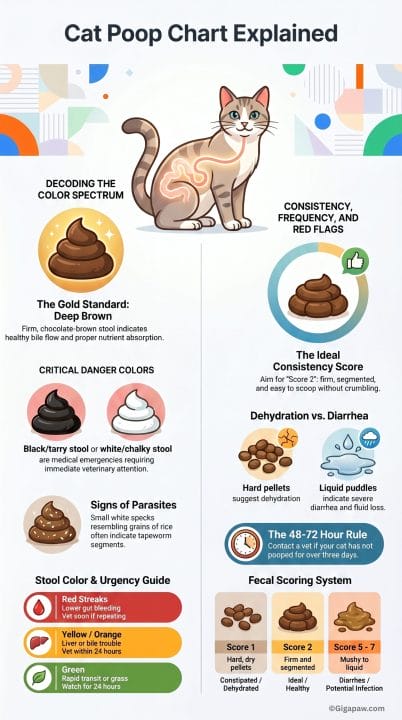
Healthy cat poop is deep chocolate brown. Not black. Not yellow. Just regular Tootsie Roll brown.
It should be firm but not rock-hard. You should be able to scoop it in one piece without it crumbling or sticking to the scoop like wet clay.
It should smell bad. Obviously. But it shouldn’t smell like something died in the walls.
And your cat should drop one or two of these a day. That’s the gold standard.
Anything way off from that baseline is worth a second look.
Cat Poop Color Chart
Color is the loudest signal your cat’s gut gives you. Here’s what each shade usually means.
| Color | What It Usually Means | How Worried Should You Be |
|---|---|---|
| Dark brown | Healthy, normal digestion | Not at all. Carry on. |
| Light brown / tan | Possible diet change or mild digestion issue | Keep an eye on it for a day or two |
| Black and tarry | Digested blood from stomach or upper gut (melena) | Vet. Today. |
| Red streaks | Fresh blood from lower gut, colon, or anus | Vet soon, especially if repeating |
| Yellow | Liver, gallbladder, or pancreas trouble | Vet within 24 hours |
| Orange | Bile duct or liver issue | Vet soon |
| Green | Rapid transit, gallbladder issue, or too many greens eaten | Watch for a day, vet if it continues |
| White / chalky / pale gray | Serious bile duct blockage | Vet immediately |
| White specks like rice | Tapeworm segments | Vet for dewormer |
Brown Is Boring. Brown Is Beautiful.
Brown poop means bile is doing its job, food is moving at the right pace, and your cat is absorbing nutrients properly.
If it looks like a Tootsie Roll, congratulations. Your cat is thriving.
Black and Tarry Is the One That Scares Vets
This is called melena, and it looks like wet asphalt. Sticky. Shiny. Smells extra awful.
It means blood is being digested somewhere high up in the gut. Stomach ulcers, serious inflammation, certain toxins, or even some cancers can cause this.
This is not a “wait and see” color. This is a drop-everything-and-call-the-vet color.
Red Streaks Mean Fresh Blood
Bright red blood on the outside of the poop usually points to something closer to the exit. Colitis, parasites, anal gland issues, or a hard stool that scraped on the way out.
One streak after a rough constipation day? Keep an eye on it. Blood showing up multiple times? Time to go in.
Yellow or Orange Means Liver or Bile Trouble
When bile flow gets disrupted, poop loses that classic brown tone and shifts toward yellow or orange. It can also happen with pancreatitis or certain infections.
If your cat’s poop turns yellow and stays yellow, don’t ignore it.
Green Poop Has a Few Explanations
Ate too much grass? Plausible. Stole a bite of something leafy? Sure.
But green poop can also mean food is moving through the gut too fast for bile to break down fully. If it keeps happening, get it checked.
White Poop Is a True Emergency
White, chalky, pale gray stool means bile isn’t reaching the intestines at all. Usually that’s a blockage between the liver, gallbladder, and gut.
This is rare but serious. Same-day vet visit, no debate.
Little White Worms or Rice Grains
Spotting what looks like tiny grains of rice stuck to the poop or your cat’s fur near the tail? That’s tapeworm segments.
It’s gross. It’s also very treatable. One dewormer from the vet usually wraps it up.
Cat Poop Consistency Chart
Color tells you one story. Consistency tells you another. Vets actually use a fecal scoring system to rate this, similar to the Bristol Stool Chart for humans.
Here’s the simple version.
| Score | Look | What It Means |
|---|---|---|
| 1 | Hard, dry pellets | Constipation. Cat needs more water or fiber. |
| 2 | Firm, segmented, easy to scoop | Ideal. This is the goal. |
| 3 | Slightly soft but still formed | Mild imbalance. Often diet-related. |
| 4 | Very soft, loses shape when scooped | Early diarrhea. Watch closely. |
| 5 | Mushy, no clear shape | Clear diarrhea. Check food and hydration. |
| 6 | Watery with some solid bits | Real diarrhea. Contact vet if it lasts more than a day. |
| 7 | Pure liquid puddle | Severe diarrhea. Same-day vet visit. |
Rock-Hard Pellets Mean Your Cat Is Dehydrated
Little dry pellets are a sign your cat isn’t drinking enough or their diet is too low in moisture.
Dry food only? That could be the culprit. Try adding a splash of water to meals or introducing some wet food.
If your cat strains for more than a minute or two with nothing coming out, that’s a vet call. Feline constipation can turn into megacolon, and that’s a condition you do not want to mess with.
Soft or Unformed Poop
A single soft poop after a diet change or a treat binge is usually nothing. Cats have sensitive guts and they react to new stuff fast.
But if soft poop shows up two or three days in a row, something’s off. Food intolerance, stress, parasites, or an infection are all on the list.
Full-On Diarrhea
Watery poop loses your cat a ton of fluid fast. Kittens and senior cats can crash hard from even one day of serious diarrhea.
If your adult cat has diarrhea that lasts more than 24 to 48 hours, or if there’s any blood in it, you need a vet. Full stop.
How Often Should Cats Poop?
This is the part where cat parents freak out unnecessarily.
- Adult cats: Once or twice a day is normal. Some healthy cats go every 24 to 36 hours and that’s still fine.
- Kittens: Two to four times a day. Their little guts move fast.
- Senior cats: Often once a day or even once every day and a half.
When Silence in the Litter Box Is a Problem
If your cat hasn’t pooped in more than 48 to 72 hours, that’s when you start paying attention.
Check if they’re eating normally. Check if they’re drinking. Check if they’re hiding or acting off.
A full three days with no poop and any sign of discomfort means vet time.
When Too Much Pooping Is a Problem
If your cat suddenly goes from one poop a day to four or five, something changed. New food? New stress? New medication?
Keep a mental note for 48 hours. If frequency stays high or the poop turns soft, go in.
Things Most Cat Parents Miss
A few extra signals that aren’t in most charts but should be.
Mucus on the poop. A bit of clear or white slimy coating can mean colon inflammation or parasites. Occasional is fine. Every day is a flag.
Hair in the poop. A little is normal, especially in long-haired cats. Clumps big enough to look like a braid mean too much grooming or not enough fiber.
The smell changes. All cat poop stinks. But if it suddenly smells way worse than usual, like rotten and sour rather than just bad, that’s often a gut bacteria imbalance or malabsorption.
Your cat poops outside the litter box. This is sometimes a litter or behavior issue. But it can also mean pain when they try to go. Painful pooping equals vet visit.
If your cat is also throwing up alongside any of this, check our cat vomit color chart too. Puke and poop together usually means something real is going on.
Diet Changes That Actually Help
Before rushing to the vet for mild stuff, a few food tweaks fix a lot of low-grade poop weirdness.
Cats are built for moisture-rich food. Dry kibble is convenient, but it’s not what their kidneys or gut evolved for. Adding wet food is the single biggest upgrade most cats need.
Switching foods should take a full seven to ten days, mixing old and new, or you’ll cause the exact diarrhea you’re trying to prevent.
Some cats with chronic soft poop do better on a limited-ingredient diet. Chicken, salmon, or turkey only, no grains, no weird fillers. A good place to start is our homemade cat food for sensitive stomachs guide.
Probiotics designed for cats can help too, especially after antibiotics. Ask your vet for a specific brand rather than grabbing something off Amazon blind.
When to Call the Vet Without Hesitation
I don’t want anyone sitting around Googling while their cat actually needs help. Here’s the short list.
- Black, tarry, or sticky poop
- White or chalky pale poop
- Blood showing up more than once
- Diarrhea lasting more than 24 to 48 hours
- No poop for more than 72 hours
- Straining for more than a minute with nothing coming out
- Worms visible in the poop or around the tail
- Poop changes paired with vomiting, weight loss, or lethargy
Cats are notorious for hiding how bad they feel. The litter box is one of the few places they can’t lie to you.
The Takeaway
Your cat’s poop is basically a daily report card for their gut. Knowing what’s normal for your specific cat makes spotting problems ten times easier.
Scoop every day. Glance before you flush. Take a mental photo of what healthy looks like.
Weird color once? Probably fine.
Weird color twice in a row? Pay attention.
Weird color plus weird behavior? Call the vet.
Your cat is counting on you to notice. And now you know exactly what to look for.