GigaPaw.com participates in affiliate programs including Amazon Associates. We earn from qualifying purchases. Content is for informational purposes only—consult a licensed veterinarian for pet medical advice.
Cat Urine Smell Remover: The Complete Guide to Winning the War Against That Horrific Stench

If you’ve ever walked into a room and been slapped in the face by the unmistakable aroma of cat pee, you know the panic.
Your brain immediately goes into detective mode, trying to figure out where your furry little criminal struck this time.
Why Cat Pee Smells Like a Biological Weapon
Let’s talk about why your cat’s urine could probably be classified as a hazardous material.
Unlike dog pee (which is basically watered-down lemonade in comparison), cat urine is insanely concentrated.
The Science Behind the Stink
Cats evolved in the desert, so their bodies are basically water-hoarding machines.
They squeeze every last drop of moisture from their food, which means their pee comes out super concentrated and dark.
Here’s what’s actually in that nightmare juice:
| Component | What It Does |
|---|---|
| Urea | Breaks down into ammonia (that sharp smell) |
| Uric Acid | Forms crystals that stick to EVERYTHING |
| Urobilin | Creates the lovely yellow color |
| Pheromones | Sends signals to other cats (and haunts you forever) |
| Bacteria | Makes everything worse as it decomposes |
The real villain here is uric acid.
This stuff forms tiny crystals that bond to surfaces like they’re paying rent.
The Zombie Smell Effect
Here’s the terrifying part: cat urine has a half-life of six years.
Those uric acid crystals can lay dormant for months or even years.
Then, when humidity increases or you steam clean your carpet (big mistake), they reactivate and release the smell all over again.
It’s like a horror movie where the monster keeps coming back.
Why Regular Cleaners Don’t Work (And What Does)
I know what you’re thinking: “I’ll just blast it with bleach!”
Stop right there.
The Bleach Disaster
Never use bleach on cat urine.
When ammonia (in the urine) mixes with bleach, it creates toxic chloramine gas.
Plus, bleach actually smells similar to cat pheromones, which basically invites your cat to pee there again.
It’s like putting up a neon “PEE HERE” sign.
Why Vinegar and Baking Soda Only Partly Work
Vinegar and baking soda are the home remedies everyone swears by.
And they do help… temporarily.
They can neutralize the ammonia smell and clean up the water-soluble parts of urine.
But here’s the problem: they can’t break down uric acid crystals.
So the smell appears to be gone, but on the next humid day, it comes roaring back like revenge.
Enzyme Cleaners: The Only Real Solution
If there’s one thing you take away from this article, let it be this: enzyme cleaners are non-negotiable.
How Enzyme Cleaners Actually Work
Enzyme cleaners contain special proteins that literally eat the organic compounds in cat urine.
They break down uric acid at the molecular level, turning it into odorless carbon dioxide and water.
No crystals left behind means no smell coming back.
It’s not magic. It’s biology.
Top Enzyme Cleaners That Actually Work
Based on thousands of user reviews, Reddit recommendations, and lab testing, here are the heavy hitters:
| Product | Best For | Notes |
|---|---|---|
| Rocco & Roxie | All-around use | 78,600+ five-star reviews on Amazon, CRI certified |
| Nature’s Miracle Urine Destroyer | Budget-friendly | Works in 15 minutes, trusted brand |
| Simple Solution Extreme | Tough stains | 3-in-1 nozzle (foam, mist, stream) |
| Angry Orange | Citrus lovers | Strong scent, works on multiple surfaces |
| Bissell Pet Stain Formula | Preventing re-marking | Lab-tested, works overnight |
The Carpet and Rug Institute seal of approval is worth looking for.
It means the product won’t destroy your carpet while trying to save it from cat pee.
How to Remove Cat Urine the Right Way
Alright, here’s the battle plan.
Step 1: Find All the Crime Scenes
You might think you know where the pee is, but cats are sneaky.
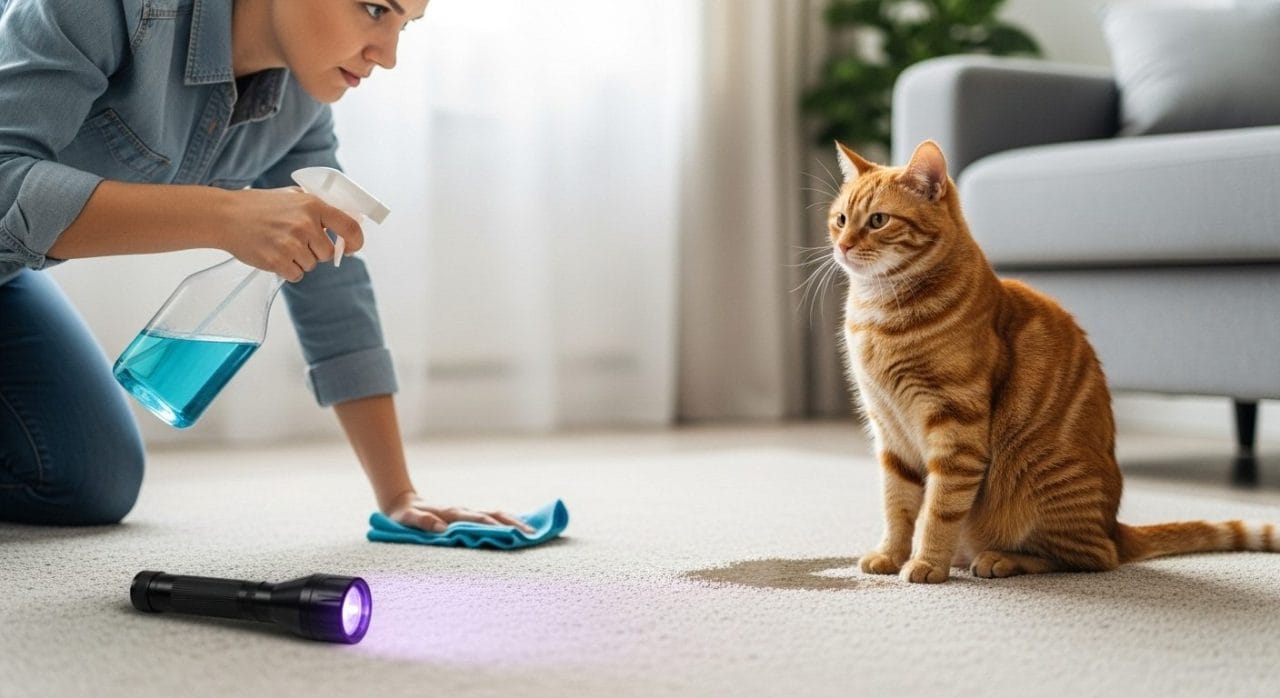
Get a UV blacklight flashlight (365-395nm range works best).
Turn off all the lights and scan your floors, walls, furniture, and anywhere your cat hangs out.
Cat urine glows under UV light like it’s at a rave.
Mark each spot with painter’s tape so you don’t lose track.
Step 2: Blot, Don’t Rub (Fresh Stains)
If the pee is still wet, you’ve got a head start.
Grab paper towels or an old cloth and blot the area.
Press down firmly to absorb as much liquid as possible.
Never rub. Rubbing pushes the urine deeper into carpet fibers and padding.
Keep blotting with fresh towels until no more moisture comes up.
Step 3: Apply Your Enzyme Cleaner
Here’s where most people mess up: you need to absolutely soak the area.
The enzyme cleaner must reach everywhere the urine went.
For carpet, that means saturating down to the padding underneath.
Pour it on. Be generous. This is not the time to be stingy.
Step 4: Let It Work (The Hard Part)
Most enzyme cleaners need 8-12 hours minimum to do their job.
Some recommend leaving it overnight or even up to 72 hours for old stains.
Cover the area with a damp cloth to keep the enzymes active.
Do not use a fan or heater to speed drying. The enzymes need moisture to work.
Step 5: Air Dry Completely
Let the area air dry naturally.
Once dry, sniff the spot.
If you still smell anything, repeat the process.
Old or severe stains might need 2-3 treatments.
Special Situations and How to Handle Them
Carpet That’s Been Soaked Repeatedly
If your cat has been using the same spot as a toilet for weeks or months, the urine has soaked through to the carpet padding and possibly the subfloor.
Here’s the unfortunate truth: you may need to pull up the carpet.
Treat the padding (or replace it entirely) and seal the subfloor with an odor-blocking primer like Zinsser before laying new carpet.
It sounds extreme, but nothing else will work.
Furniture and Mattresses
Cushions and mattresses are basically giant sponges.
Remove cushion covers if possible and soak the foam directly with enzyme cleaner.
Let it sit for 15 minutes, then squeeze out the excess.
This might take several days to dry completely.
Throw aluminum foil over the area to keep your cat from re-offending while it dries.
Hardwood Floors
Wood is tricky because urine can warp and stain it.
Use an enzyme cleaner specifically marked as safe for hardwood.
If the urine has penetrated the wood, you might need to sand and reseal the affected area.
Laundry (Clothes, Blankets, Towels)
Pre-soak the item in enzyme cleaner for 20-30 minutes.
Then wash on hot (if the fabric allows) with your regular detergent.
Add a cup of the enzyme cleaner to the wash cycle for extra power.
Never put urine-soaked items in the dryer until the smell is completely gone. Heat sets the stain permanently.
The DIY Route: Homemade Solutions
If you’re in a pinch and can’t get to the store, here’s a recipe that works decently:
The Hydrogen Peroxide Method
Ingredients:
- 1 cup 3% hydrogen peroxide
- 1 teaspoon dish soap
- Baking soda
Steps:
- Blot up as much urine as possible
- Soak the area with a 50/50 mix of white vinegar and water
- Let it sit for 15 minutes, then blot dry
- Sprinkle baking soda over the area
- Mix the hydrogen peroxide with dish soap and pour over the baking soda
- Let it dry completely, then vacuum
Warning: Hydrogen peroxide can bleach carpet and fabrics. Always test in a hidden area first.
This method handles the ammonia and provides temporary odor relief.
But remember: it won’t break down uric acid crystals like enzyme cleaners do.
For complete, permanent odor removal, you’ll still want to follow up with an enzymatic product.
What NOT to Do (Common Mistakes)
Let’s save you from learning these the hard way:
Never Use a Steam Cleaner First
High heat permanently bonds urine proteins to carpet fibers.
The smell will be locked in forever.
If you want to steam clean, always treat with enzyme cleaner first and let it dry completely before steaming.
Never Mix Cleaning Products
Don’t use multiple products at once.
Bleach + ammonia = toxic gas.
Other cleaners can deactivate enzymes.
Pick one method and stick with it.
Don’t Skimp on Soak Time
Enzyme cleaners aren’t instant.
If you spray and wipe immediately, you’ve wasted your money.
Let them work. Be patient. Trust the process.
Don’t Forget the Padding
Surface cleaning is not enough for carpet.
If you can smell it, the urine reached the padding.
Treat accordingly.
Preventing Future Accidents
Once you’ve won the battle, let’s prevent the next war.
Rule Out Medical Issues
Cats don’t pee outside the litter box for fun.
Urinary tract infections, kidney disease, diabetes, and arthritis can all cause accidents.
If your cat suddenly starts having accidents, vet visit first.
Litter Box Basics
The general rule is: one litter box per cat, plus one extra.
Scoop daily. Change litter weekly.
Make sure the box is in a quiet, accessible location.
Older cats might need boxes with lower sides.
Complete Odor Removal Is Essential
Cats have noses that are 14 times more sensitive than ours.
If any urine smell remains, your cat will keep coming back to that spot.
This is why enzyme cleaners are so important.
You might not smell anything, but your cat definitely can.
The Bottom Line
Cat urine smell is one of the most stubborn odors on the planet.
But it’s not unbeatable.
The formula for success is simple:
- Find all affected areas with a UV blacklight
- Blot fresh stains immediately
- Saturate with enzyme cleaner
- Let it work for 8-24 hours
- Air dry completely
- Repeat if necessary
Skip the vinegar, forget the bleach, and invest in a quality enzyme cleaner.
Your nose will thank you.
Your cat will stop revisiting the scene of the crime.
And your home will finally smell like a place where humans live instead of a litter box.
Now go reclaim your house from the tyranny of cat pee.
You’ve got this.