GigaPaw.com participates in affiliate programs including Amazon Associates. We earn from qualifying purchases. Content is for informational purposes only—consult a licensed veterinarian for pet medical advice.
Cat Years to Human Years: The Real Math Behind Your Cat’s Age

So you’ve been told that 1 cat year equals 7 human years, right?
Yeah, that’s wrong. Like, not even close.
The actual way cats age is way weirder and way more interesting than that simple math. And once you understand it, a LOT of your cat’s behavior is going to start making sense.
Let me break it down.
The “1 Equals 7” Myth Needs to Die
Here’s where this myth falls apart instantly.
A 1-year-old cat can hunt, reproduce, and survive on its own. A 7-year-old human can barely tie their shoes without a meltdown.
See the problem?
Cats don’t age in a neat, straight line like that formula suggests. They front-load their aging like crazy in the first couple of years, then slow way down after that.
How Cat Years to Human Years Actually Works
The real conversion goes like this, and it’s backed by veterinary organizations like the American Animal Hospital Association (AAHA) and the American Association of Feline Practitioners (AAFP).
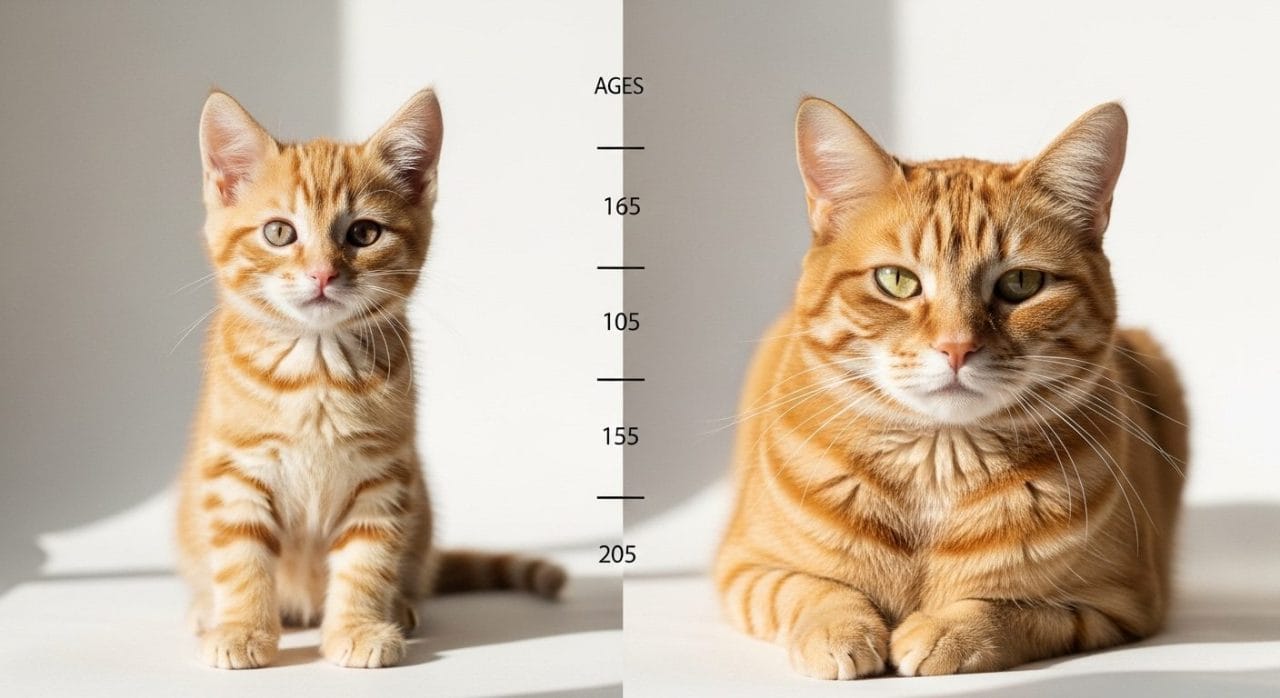
Year 1: Your cat hits the equivalent of 15 human years. That tiny kitten who was stumbling around your living room six months ago? Already a moody teenager.
Year 2: Add another 9 human years. Your cat is now the equivalent of a 24-year-old human. Fully grown, fully mature, probably thinks they know everything. Sound familiar?
Year 3 and beyond: Each cat year after that equals roughly 4 human years.
That’s it. That’s the formula.
Cat Years to Human Years Chart
Here’s the full breakdown so you don’t have to do any math (you’re welcome):
| Cat’s Age | Human Equivalent |
|---|---|
| 1 year | 15 years |
| 2 years | 24 years |
| 3 years | 28 years |
| 4 years | 32 years |
| 5 years | 36 years |
| 6 years | 40 years |
| 7 years | 44 years |
| 8 years | 48 years |
| 9 years | 52 years |
| 10 years | 56 years |
| 11 years | 60 years |
| 12 years | 64 years |
| 13 years | 68 years |
| 14 years | 72 years |
| 15 years | 76 years |
| 16 years | 80 years |
| 17 years | 84 years |
| 18 years | 88 years |
| 19 years | 92 years |
| 20 years | 96 years |
So if someone tells you their cat is 15, you’re basically talking to someone who owns a 76-year-old roommate who knocks things off tables for fun.
Why Do Cats Age So Fast in the First Two Years?
This one blew my mind when I first learned it.
Cats go through puberty at around 4 to 6 months old. They can literally get pregnant before they’re even done being kittens themselves.
By their first birthday, they’ve developed full adult teeth, reached their adult size, and have basically crammed 15 years of human development into 12 months.
It’s like watching someone speedrun childhood.
By year two, they’ve hit the equivalent of their mid-20s. Physically mature, mentally still figuring things out, and convinced they’re invincible. So basically, every 24-year-old you’ve ever met.
The 5 Life Stages of a Cat (According to Vets)
The 2021 AAHA/AAFP Feline Life Stage Guidelines break a cat’s life into these stages:
Kitten (Birth to 1 Year)
This is the equivalent of ages 0 to 15 in human years.
Everything is new, everything is a toy, and your ankles are under constant attack. Kittens develop insanely fast during this stage, learning survival skills, social behavior, and exactly which furniture to destroy.
Young Adult (1 to 6 Years)
Human equivalent: 15 to 40 years old.
This is your cat in their prime. Peak energy, peak health, peak attitude. They’re athletic, curious, and still think 3 AM is the perfect time for zoomies.
Mature Adult (7 to 10 Years)
Human equivalent: 44 to 56 years old.
Your cat is officially middle-aged. They might start slowing down a little. Maybe they choose the sunny spot on the couch over chasing a laser pointer. Very “I’d rather stay in tonight” energy.
Senior (10+ Years)
Human equivalent: 56 to 76+ years old.
This is when age-related health stuff can start showing up. Arthritis, kidney issues, thyroid problems, and a general attitude of “I will sit where I want, and you will deal with it.”
End of Life
This stage is covered by separate veterinary guidelines and focuses on comfort, dignity, and quality of life.
How Long Do Cats Actually Live?
The average cat lifespan is around 12 to 14 years, but plenty of cats blow right past that.
Indoor cats typically live 15 to 17 years, and some make it past 20. The safety of being inside, away from traffic, predators, and diseases, makes a massive difference.
Outdoor cats have a much shorter average lifespan of only 2 to 5 years. That’s not a typo. The risks out there (cars, other animals, toxic stuff, diseases) are brutal.
So if you’ve got an indoor cat who just turned 16, congratulations. In human years, you’re living with an 80-year-old who still demands breakfast at 5 AM and judges your every life decision.
The Oldest Cat That Ever Lived
Ready for this?
A cat named Creme Puff from Austin, Texas, lived to be 38 years and 3 days old. That’s roughly 168 human years.
Her owner, Jake Perry, also had another cat named Granpa Rex Allen who lived to 34. The man clearly knew something the rest of us don’t.
According to Perry, Creme Puff’s diet included dry cat food, eggs, turkey bacon, broccoli, coffee with cream, and a tiny bit of red wine every couple of days. Is that a vet-approved diet? Absolutely not. Did it work for Creme Puff? Apparently yes.
And the current oldest living cat? That’s Flossie, a British cat who turned 30 years old in December 2025. She’s blind and deaf, but still going strong, enjoys cuddles and big bowls of food.
What Determines How Long Your Cat Will Live?
Several factors play into your cat’s lifespan:
Indoor vs. Outdoor
This is the single biggest factor. Indoor cats live significantly longer than outdoor cats. It’s not even close.
Breed
Mixed-breed cats tend to live longer than purebreds, thanks to more genetic diversity. Among purebreds, Siamese and Burmese cats are known for longer lifespans of 15 to 20 years, while larger breeds like Maine Coons average 10 to 13 years.
Spay/Neuter Status
Here’s a big one. Spayed and neutered cats live longer. A UC Davis study found that intact cats of both genders had significantly shorter lifespans. Fixing your cat reduces the risk of reproductive cancers and eliminates hormone-driven risky behavior.
Diet and Exercise
Obesity is one of the biggest health threats to indoor cats. A balanced diet and regular playtime aren’t optional if you want your cat to stick around.
Veterinary Care
Regular check-ups catch problems early. Cats are masters at hiding pain and illness, so annual vet visits (and twice a year for seniors) are a must.
How to Tell Your Cat’s Age If You Don’t Know It
Adopted a stray and have no clue how old they are? Vets look at a few things:
Teeth are the best clue. White teeth usually mean under 1 year old. Yellowing suggests 1 to 2 years. Tartar buildup points to 3 to 5 years. Missing teeth or serious wear usually means a senior cat.
Fur gets coarser and thicker with age. Gray or white patches can appear in older cats, just like humans going gray.
Eyes may develop cloudiness after about 12 years of age.
Muscle tone decreases in older cats. They might feel bonier, with protruding shoulder blades and less definition.
Why Does Any of This Matter?
Knowing your cat’s age in human years isn’t just a fun party fact (though it IS a fun party fact).
It helps you understand what they need at each stage of life. A 2-year-old cat tearing up your furniture isn’t being a jerk. They’re basically a college kid with claws. A 15-year-old cat who’s suddenly picky about food might be dealing with age-related health changes that need a vet’s attention.
Cats can’t tell us when something’s wrong. But when you know that your 10-year-old cat is really a 56-year-old, you start thinking differently about those subtle changes in behavior.
The Bottom Line
Your cat is probably older than you think.
That 5-year-old kitten you still call “baby”? They’re 36 in human years. That senior cat who’s been with you for 15 years? They’re 76, and they’ve earned every single nap.
The best thing you can do is keep them indoors, feed them well, get them to the vet regularly, and give them the love they pretend they don’t need.
Because if Creme Puff taught us anything, it’s that cats can stick around for a really, really long time when somebody takes good care of them.
Now go check the chart and figure out how old your cat really is. I guarantee it’ll change how you look at them tonight.