10 Creative Cat-Friendly Christmas Tree Ideas for Festive Fun!
Look, we need to talk about the annual holiday battle happening in millions of homes right now.
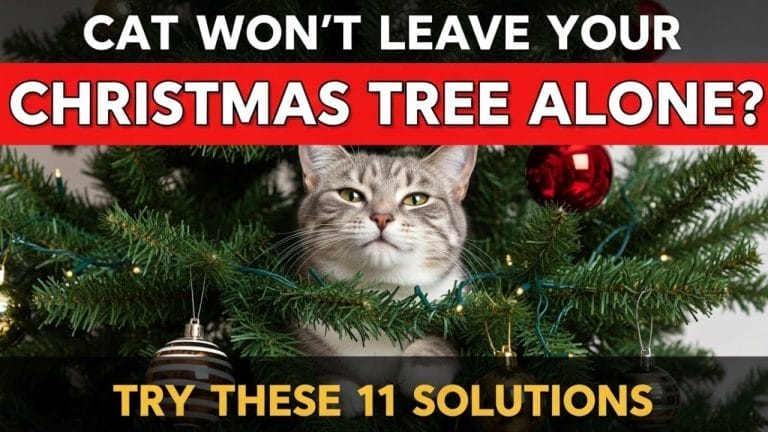
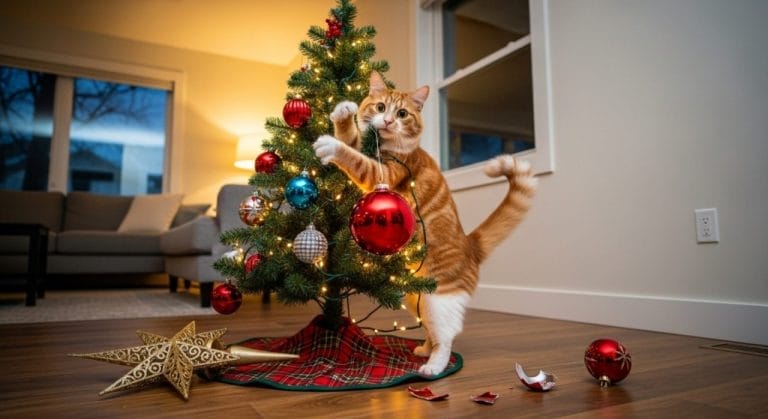
You spend hours decorating a gorgeous Christmas tree, step back to admire your work, and approximately 3.5 seconds later, your cat is already halfway up it like it’s Mount Everest.
A recent study found that 72% of pet owners reported their pets knocked down their Christmas tree or ornaments. That’s not a small problem—that’s basically a holiday epidemic.
Your cat sees that tree and thinks “jungle gym.” You see it and think “family heirloom ornaments about to become shrapnel.” Nobody wins.
But here’s the thing: you don’t have to choose between festive vibes and feline chaos.
Why Your Cat Is Obsessed With Your Christmas Tree
Before we dive into solutions, let’s understand what we’re dealing with here.
Cats are naturally attracted to dangling, shiny objects, and Christmas trees offer new scents, textures, and ornaments that mimic natural playthings. From your cat’s perspective, you literally brought their dream toy into the house.
The twinkling lights look like prey moving. The branches feel like actual trees they’d climb in the wild. The ornaments are basically asking to be batted around.
Your cat isn’t being bad—they’re being exactly what they are.
By the way, if you're into DIY Hacks stuff, you’ll wanna check this one out: 20+ DIY Cat Christmas Gifts You Can Actually Make
The Real Dangers (Not Just Broken Ornaments)
Yeah, broken glass ornaments suck. But the actual dangers are way more serious.
Real Christmas trees are considered mildly toxic to cats when chewed or ingested, and tinsel can become stuck in their mouth or intestinal tract, causing a blockage which can be life-threatening. That’s not “oops, there goes grandma’s antique bauble” territory—that’s emergency vet visit territory.
Pine needles can stick in your cat’s paws and cause choking if eaten, while tree water often contains preservatives, fertilizers, and pesticides that are harmful to cats. Even the seemingly innocent parts of your tree setup are basically booby traps.
Add in electrical cords that curious cats might chew, heavy trees that can topple and trap them underneath, and you’ve got a recipe for disaster wrapped in tinsel.
So yeah, maybe it’s time to rethink the whole traditional tree situation.
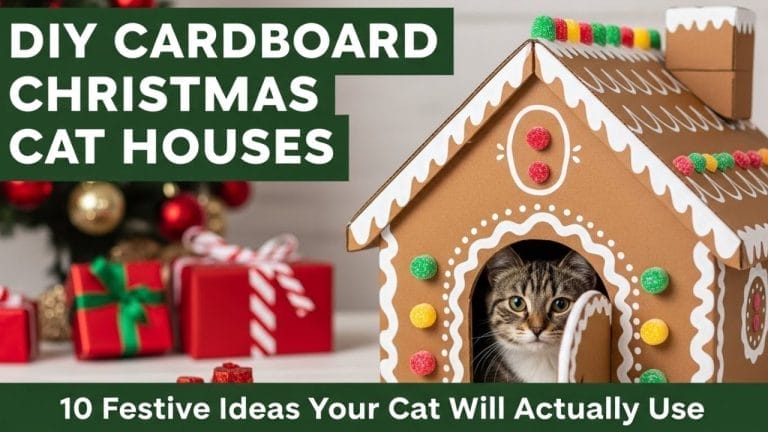
Oh, and speaking of DIY Hacks, here’s another one you might like: 10 DIY Cardboard Christmas House Ideas for Cats
10 Cat-Friendly Christmas Tree Alternatives That Actually Work
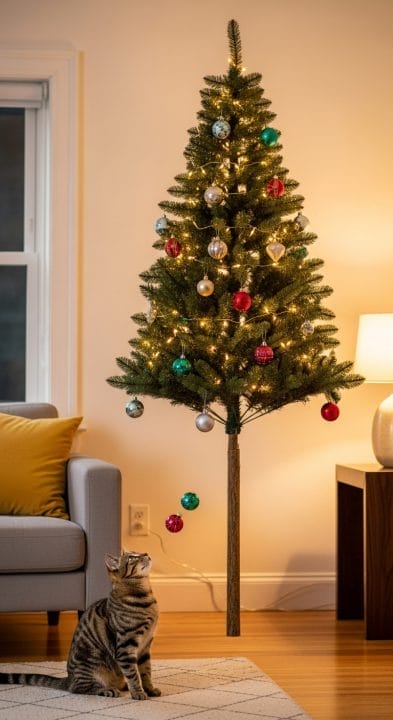
1. The High-Branch Tree (For the “Maybe They’ll Lose Interest” Crowd)
Amazon sells cat-friendly Christmas trees with taller trunks and zero lower branches, preventing curious cats from easily accessing ornaments. The bottom portion is just trunk—no tempting branches, no dangly decorations.
Does it look a little weird? Sure. Like you gave up decorating halfway through? Maybe.
But your ornaments stay intact and your cat stays safe, so that’s a win.
These trees typically cost around $100, making them way cheaper than replacing broken heirlooms every year.
2. Wall-Mounted Trees (Cats Can’t Knock Over What’s on the Wall)
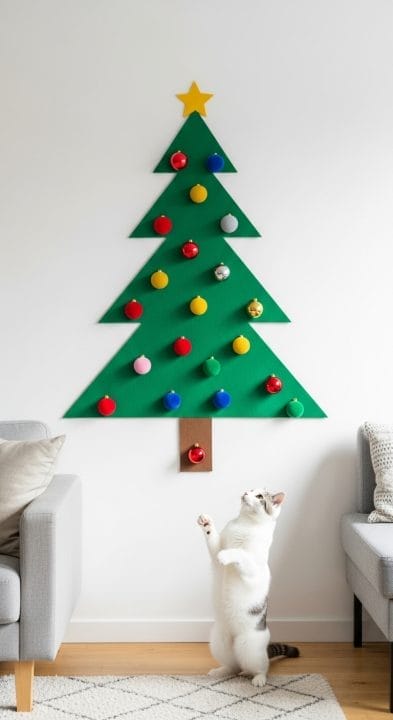
Wall trees can be created using fabric, felt, string lights, or even photos from previous holidays arranged in a tree shape. Your cat can’t climb it because it’s literally flat against the wall.
You can make one yourself with green felt and velcro ornaments, or buy pre-made options online.
The best part? Even if your cat does try to mess with it, the worst that happens is a few ornaments fall off. No timber!
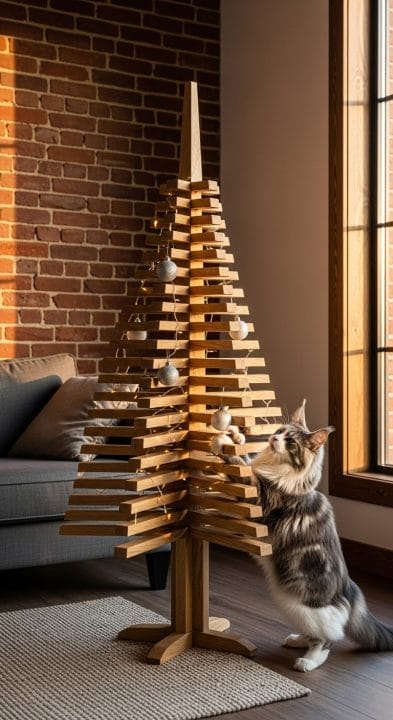
3. Wooden Slat Trees (Built Like a Tank)
Wooden slat trees are made from wooden pieces arranged in tree shapes—they’re strong, stable, and nearly impossible for cats to knock over. They’re basically the Fort Knox of Christmas trees.
Your cat might try to scratch them (they are made of wood, after all), but these trees can handle it.
The wooden tree won’t become easily damaged when your cat climbs it, and there are no dried-out pine needles or tree sap to worry about. Plus they look pretty cool in a minimalist, modern way.
4. Tabletop Trees (High and Mighty)
Tabletop Christmas trees can be placed on high surfaces out of your cat’s reach, such as mantels, bookcases, or wall-mounted shelves. Just make sure whatever surface you choose is actually stable.
These mini trees still give you that Christmas tree vibe without the full-scale battlefield situation.
Go for artificial versions with plastic ornaments so if disaster does strike, nobody gets hurt.
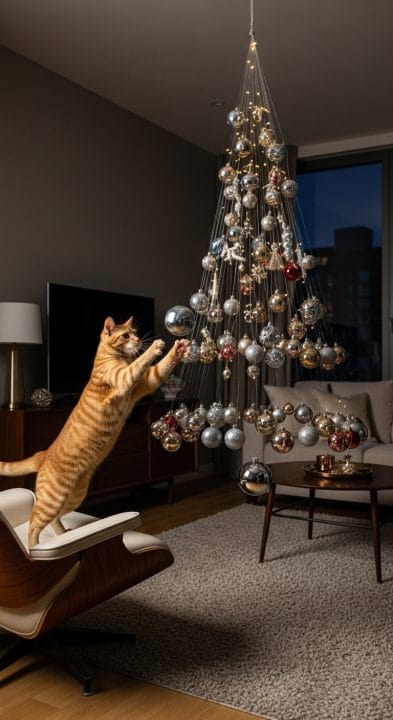
5. Suspended/Hanging Trees (Gravity-Defying Festivity)
Suspended Christmas trees made from decorative collections of baubles hang from the ceiling, keeping ornaments completely out of paw’s reach. It’s like Christmas tree meets chandelier.
The trick is hanging it high enough that even your most athletic jumper can’t reach it.
In 12th-century Europe, hanging Christmas trees upside down from the ceiling was actually traditional, so you’re being historically accurate. Take that, judgmental relatives.
6. Christmas Tree Shelf/Ladder Trees
Christmas tree shelves are ideal for cat owners and take up very little space, though cats may still see them as climbable ladders. These are basically wall shelves arranged in a tree shape that you decorate.
They double as storage, which is pretty smart. But fair warning—if your cat’s a climber, they might see this as a challenge.
Place ornaments on higher shelves and keep breakables secured or skip them entirely.
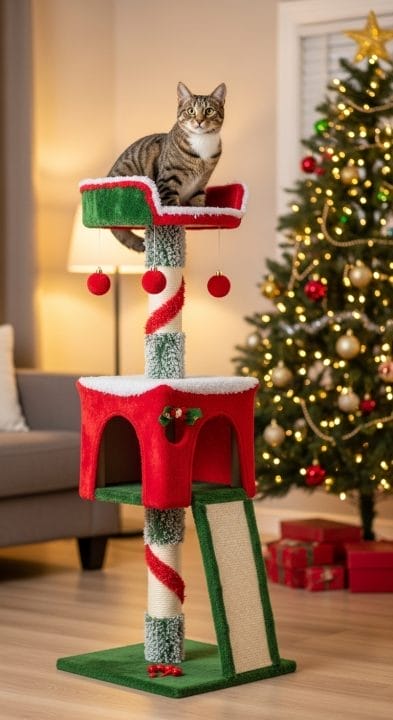
7. A Christmas-Themed Cat Tree (Fighting Fire With Fire)
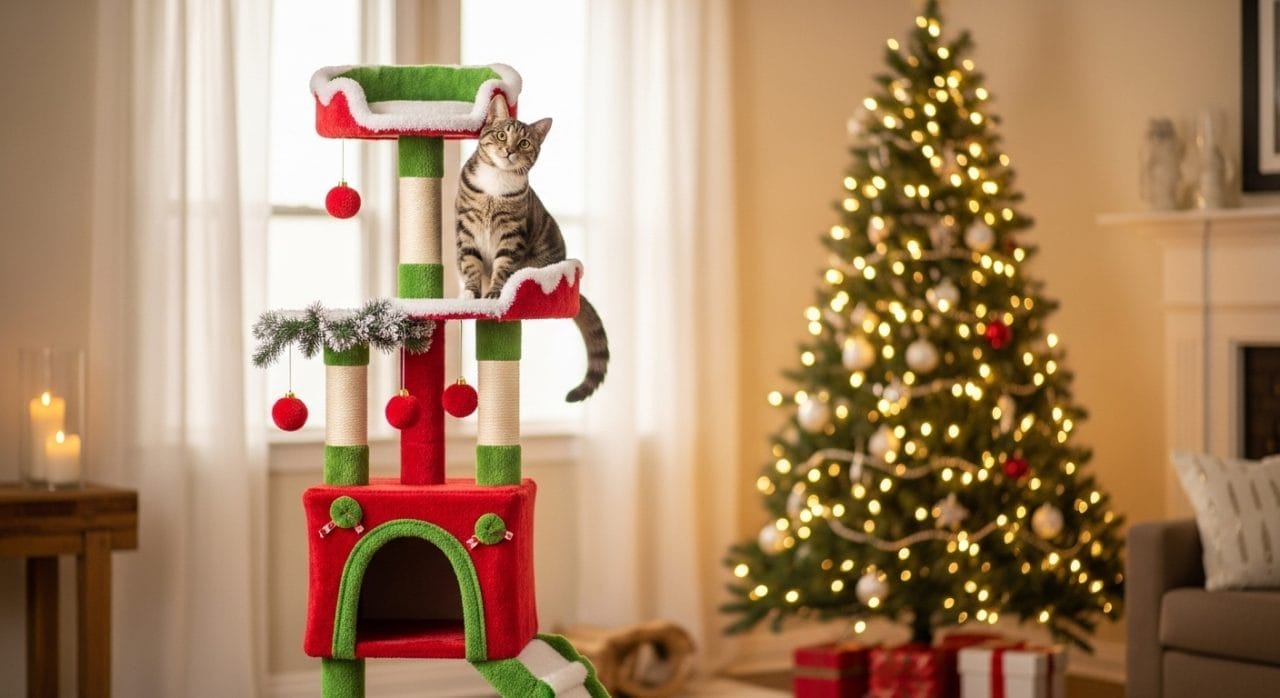
Christmas-themed cat trees decorated with red ornaments give cats their own festive structure to climb, potentially redirecting their attention from your actual tree. It’s basically calling your cat’s bluff.
These typically stand around 31 inches tall and come with scratching posts already built in.
Will your cat still mess with your real tree? Maybe. But at least they have their own option now, and you tried.
8. DIY Felt Tree (For the Crafty and Desperate)
Felt Christmas trees made for kids hang on walls with flat felt ornaments that cats are less interested in since they don’t dangle or sparkle. No moving parts = less interesting to cats.
You can make one yourself or buy them online pretty cheap.
Your cat might still paw at it occasionally, but there’s nothing to break, nothing to chew, and nothing to knock over.
9. Christmas Cactus Display (The Plot Twist Nobody Expected)
Christmas cacti are pet-friendly, non-toxic alternatives that can be decorated with festive ribbons and tiny ornaments while providing year-round greenery. Who says Christmas trees have to be pine-shaped?
You can arrange multiple cacti on a tray with pine cones and small decorations around them for a festive display.
Christmas cacti bloom with vibrant bell-shaped flowers right in winter, adding natural festive color. Plus they’re way easier to keep alive than cut trees.
10. Book Tree (For Readers With Steady Hands)
Stacked books arranged in a tree shape create a stable, decorative alternative, though playful cats might damage books if they try to climb. This one’s a calculated risk.
Use books you don’t mind getting a little beat up, stack them in a pyramid shape, and add lights or small decorations.
It looks gorgeous on Instagram and your cat probably won’t bother with it unless they’re particularly destructive.
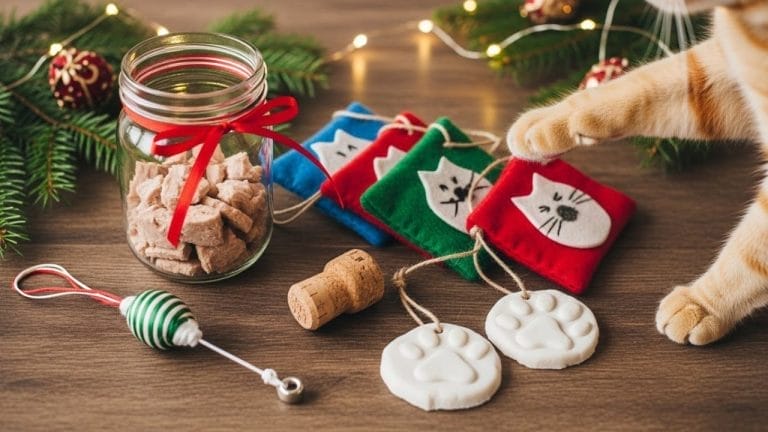
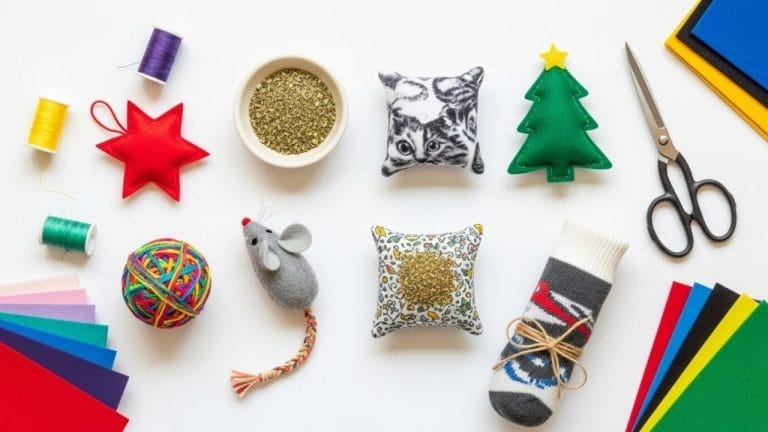
Also, just throwing this in—this DIY Hacks post is a fun read too: Make Your Cat’s Christmas: Easy DIY Catnip Toys They’ll Go Nuts For
Extra Safety Tips (Because Cats Gonna Cat)
Even with alternative trees, you’re not completely out of the woods yet.
Set up your tree a few days before decorating to let your cat investigate and hopefully get bored with it first. Cats are less interested in things they’ve already thoroughly sniffed.
Secure traditional trees to walls with wire near the top to prevent them from toppling over. Physics is not your friend when cats are involved.
Wrap tree trunks in aluminum foil because cats hate the feel of foil on their feet and will likely leave it alone. It’s not pretty, but it works.
Spray pine cones with apple cider vinegar as a natural cat repellent. Some cats find the smell offensive enough to stay away.
Create a designated play area with treats, toys, and scratching posts away from the tree. Sometimes distraction is the best defense.
The Bottom Line: Choose Your Battle Wisely
Unfortunately, 100% cat-proof Christmas trees don’t exist—a determined cat will get into even the most hard-to-reach places. But these alternatives make it way less likely.
You can have Christmas decorations AND keep your cat safe. You just might have to get creative about what “Christmas tree” actually means in your house.
Some years you’re putting up a full 6-foot Douglas fir with all the trimmings. Other years you’re hanging a felt tree on the wall and calling it festive.
Both are valid. Neither makes you a bad decorator or a bad cat parent.
The goal isn’t perfection—it’s making it through the holidays without a trip to the emergency vet or tears over broken heirlooms.
And honestly? That wall-mounted tree made from string lights might become your favorite tradition yet.
Your cat will still probably try something. But at least now you’re ready for it.