GigaPaw.com participates in affiliate programs including Amazon Associates. We earn from qualifying purchases. Content is for informational purposes only—consult a licensed veterinarian for pet medical advice.
Dog-Proof Cat Litter Box Ideas: 9 Ways to Stop Dogs From Raiding the Box

So your dog has discovered the litter box. And you’ve discovered the truly horrifying reality that your two pets do not, in fact, share boundaries.
You scoop. They beat you to it. You buy the fancy box with the flap. They figure that out in 48 hours.
I’ve been there. Half the multi-pet households I know have been there. And I’m here to tell you that yes, you can actually fix this without rehoming the dog or stationing yourself outside the bathroom 24/7.
Here are 9 dog-proof cat litter box ideas that genuinely work, ranked roughly from “easiest tonight” to “weekend project.”

Why This Is Actually a Problem (Not Just Gross)
Look, I know. The first concern is that it’s disgusting. That’s valid.
But the real reason vets bang on about this is that cat poop can carry roundworms, hookworms, salmonella, E. coli, and giardia. Your dog isn’t just snacking on something gross. They’re potentially picking up a parasite buffet.
It gets worse. Clumping cat litter expands when it hits stomach moisture. A dog that swallows enough of it can end up with a real intestinal blockage and a real emergency vet bill.
And if your cat is on any medications, drug residue passes through their poop. Your dog is now self-medicating with someone else’s prescription.
So yes. This is worth solving.
Why Your Dog Won’t Stop Doing It
Quick reality check before we get to fixes. Cat food is high in protein, so cat poop smells like food to a dog. To them, the litter box is basically a snack bar.
That’s instinct. You can train your dog to “leave it” all day, but the moment you’re out of the room, instinct wins. Which is why the only reliable fix is making the box physically unreachable, not relying on the dog to behave.
With that out of the way, here’s what actually works.
1. Top-Entry Litter Box (The Easiest Win)
A top-entry litter box looks like a normal covered box but the only opening is on the lid. Your cat hops up and drops in. Your dog stares at it like it’s a closed elevator.
This works on most small to medium dogs because they can’t physically scale a smooth plastic side and stick their head through a hole on top. Cats are climbers. Dogs are not.
Two options most people land on:
- ModKat XL has a swappable lid so you can run it as top-entry or front-entry depending on your cat’s preference
- IRIS USA Round Top Entry is cheaper, and the textured lid doubles as a paw-cleaning mat
If your cat is older, arthritic, or a kitten still learning depth perception, skip this one. They need a flatter entry.
2. The Door Buddy Strap (10-Minute Fix)
This is the laziest brilliant solution on the list.
You stick a Door Buddy strap (3M adhesive, no drilling) onto a door frame. The strap holds the door open about 4 to 6 inches. Cat slips through. Dog gets stuck at the shoulders.
Best for: any closet, laundry room, half-bath, or spare bedroom you can dedicate as the litter zone.
The whole install takes ten minutes and costs under twenty bucks. If your dog is a determined squeezer, the strap is adjustable so you can dial the gap down to cat-only width.
3. Cat Hole in a Closet or Pantry Door
If you’ve got a hollow-core interior door and you own a jigsaw, you can make this happen in one afternoon.
Cut a 6 to 7 inch wide hole about 3 to 4 inches off the floor. Sand the edges, paint to match, done. Your cat now has a private bathroom and your dog is cosmetically excluded.
For renters who want zero damage, mount a cat-sized pet door panel into a tension rod doorway curtain instead. No cutting, no deposit loss.
4. Hidden Litter Box Cabinet (The “Looks Like Furniture” Move)
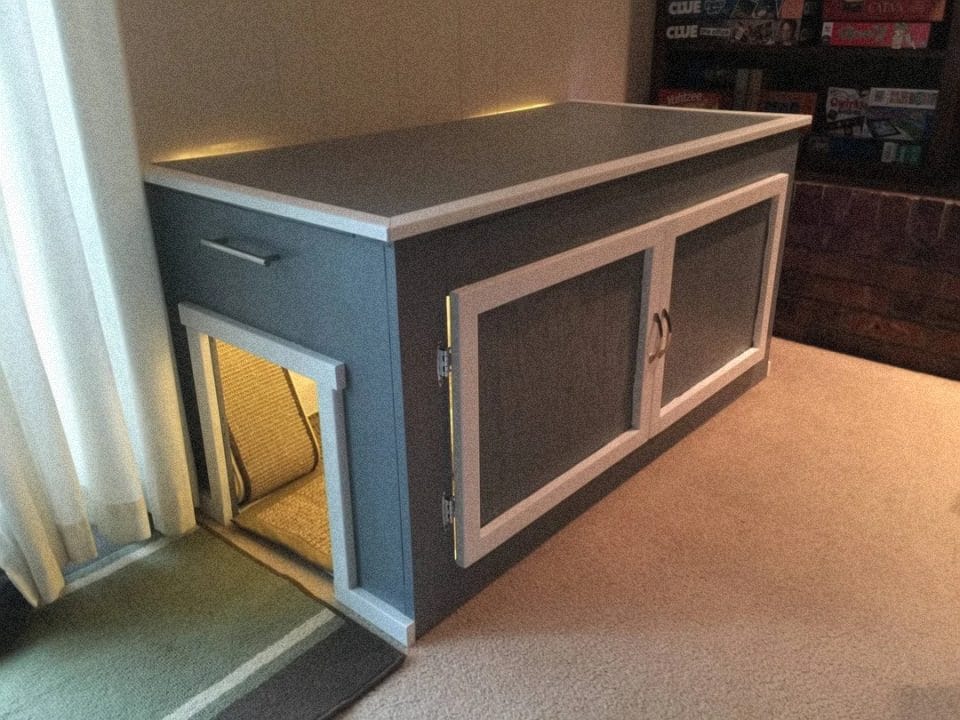
This is the one I’d push hardest if your living space is small and the litter box currently lives in the open.
Litter box cabinets (Shop hidden litter box furniture on Amazon) like the Out of Sight Litter Box or any of the Wayfair/Amazon dog-proof enclosures work because:
- The entry hole is on one side, sized for a cat
- There’s a dog-proof shelf built in that creates an L-shape the dog can’t navigate even if they fit through the hole
- It looks like a normal piece of furniture, so your living room stops looking like a vet’s lobby
Some models have a built-in power outlet for self-cleaning boxes and a litter collector drawer that grabs paw-tracked litter on the way out. We covered five options in our hidden cat litter box benches roundup and the cat litter box cabinet roundup if you want specific picks.
5. The DIY Storage Bin Maze
Reddit’s favorite zero-budget answer. And honestly, it works.
You need two plastic storage bins. One 40-quart, one 60-quart.
| Step | What to do |
|---|---|
| 1 | Cut a 6-inch hole in the side of the 40-quart bin near the top |
| 2 | Cut a 6-inch hole in the side of the 60-quart bin near the bottom |
| 3 | Place the 40-quart bin inside the 60-quart bin, with the holes on opposite sides |
| 4 | Fill the inner bin with litter |
Your cat enters the bottom hole, walks the gap between the two bins, and hops up through the inner hole into the litter. A dog can’t make that turn even if they fit through the first hole. Their body geometry won’t let them U-turn inside.
Total cost: about $25. Total time: 30 minutes with a box cutter and a heat gun (or a hairdryer if you’re patient).
6. Elevated Litter Box Station

Cats jump. Dogs (mostly) don’t.
If you have a small dog, putting the litter box on top of a sturdy shelf, dresser, or wall-mounted platform 30+ inches off the ground solves the problem instantly. The box is still accessible to your cat. Your dog just looks up at it confused.
For larger dogs, you need to go higher. A wall-mounted shelf at 40 to 48 inches with a stair-step approach for the cat works for most retrievers and shepherds.
Skip this idea if your cat is overweight, senior, or has joint issues. They need ground-level access.
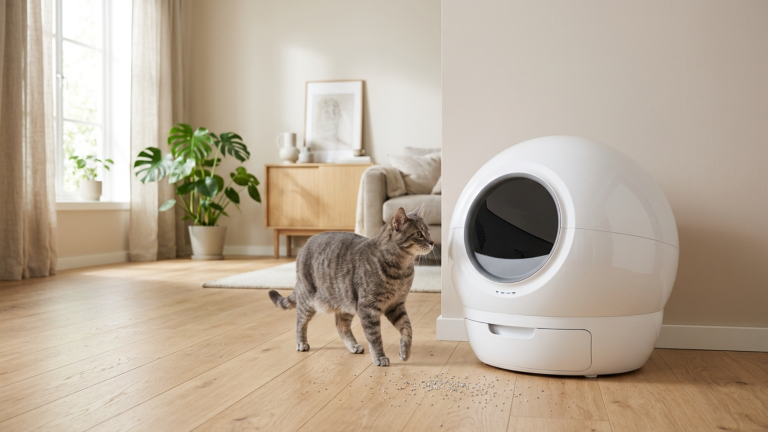
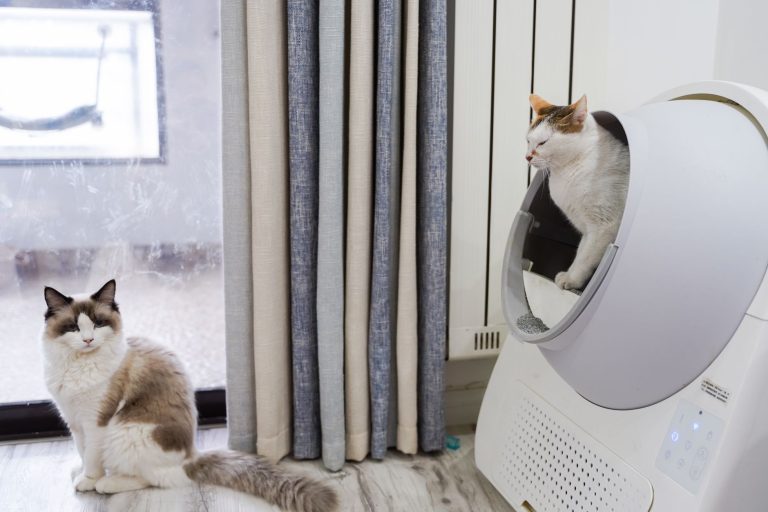
7. Self-Cleaning Litter Box (Speed Kills the Snack)
Dogs raid the box because cat poop is sitting there. Remove the poop within 30 seconds of deposit and the snack opportunity disappears.
A self-cleaning box like the Litter-Robot 4 or Whisker Litter-Robot 3 rakes waste into a sealed compartment within seconds of the cat leaving. By the time the dog gets there, it’s gone and locked up.
You’ll still want to pair this with #4 (a dog-proof enclosure), because some dogs will figure out how to open the waste drawer. But combined, this is genuinely the most “set it and forget it” solution on the list.
It’s also the most expensive. Budget $500 to $700 for the box plus another $200 to $400 for the enclosure cabinet.
8. Baby Gate With a Built-in Cat Door
If a Door Buddy isn’t your style and you want something that works on an open doorway, a baby gate with a small pet door at the bottom is the move.
The Carlson Pet Products Extra Tall Walk-Thru Gate with Pet Door has a 7″ x 7″ cat-sized opening. Big enough for a cat. Too small for any dog over about 12 pounds.
This is also the right answer if your dog is small and won’t be stopped by a Door Buddy gap. A rigid pet-door cutout is harder to wedge through than a strap-held gap.
9. Behavior Plus Logistics (The Boring But Real One)
I’m not going to pretend behavior alone will fix this. It won’t.
But layered on top of one of the physical solutions above, these things meaningfully reduce raiding pressure:
- Scoop immediately after your cat goes. No poop, no snack.
- Bitter apple spray on the litter clumps. Some dogs hate it, some don’t care. Worth the $8 test.
- Exercise the dog more. Bored dogs scavenge more. Tired dogs sleep through cat trips.
- Feed the dog a high-quality, high-protein diet. Some vets think nutrient-seeking is part of the picture, especially if your dog is on a low-grade food.
- Train a hard “leave it” with high-value rewards. Won’t replace a physical barrier but reduces opportunistic raids when you’re in the room.
The combo that works for most multi-pet households I know is: a top-entry box (#1) inside a hidden cabinet (#4), placed in a room behind a Door Buddy (#2). Triple-locked. Your dog has to be a literal raccoon to get in.
Picking the Right Setup for Your House
Here’s a quick decision matrix.
| Your situation | Best idea |
|---|---|
| Renter, no drilling allowed | Door Buddy (#2) + top-entry box (#1) |
| Have a closet or laundry room | Cat hole in the door (#3) or Door Buddy (#2) |
| Living room / open layout | Hidden litter box cabinet (#4) |
| Tight budget, willing to DIY | Storage bin maze (#5) |
| Senior cat, no climbing | Cat hole in door (#3) + baby gate with pet door (#8) |
| Want hands-off luxury | Self-cleaning box (#7) inside cabinet (#4) |
| Small dog, big cat | Elevated platform (#6) |
| Big dog, determined raider | Cabinet (#4) + Door Buddy (#2) double-lock |

Stop Sharing Your Cat’s Bathroom With Your Dog
Real talk: this is one of those problems that feels impossible until you commit to actually solving it. Then it’s pretty easy.
Pick one physical barrier from this list. Pair it with one or two behavior tweaks from #9. You’ll be done with the dog-poop-snack era inside a week.
Your cat gets privacy. Your dog gets a parasite-free GI tract. You get to stop yelling “DROP IT” at 6 a.m.
Everybody wins.
If you’re also trying to hide the box from human eyes, our hidden cat litter box ideas roundup goes deep on the decor side. And if you’re setting up a multi-pet household more broadly, keeping peace in a multi-cat home covers a lot of the resource-guarding logic that applies here too.